
Democracy: Unconstitutional Govt Changes Require Direct, Measured Response—Speaker Abbas
urges ECOWAS Parliament to replicate House's parliamentary friendship groups

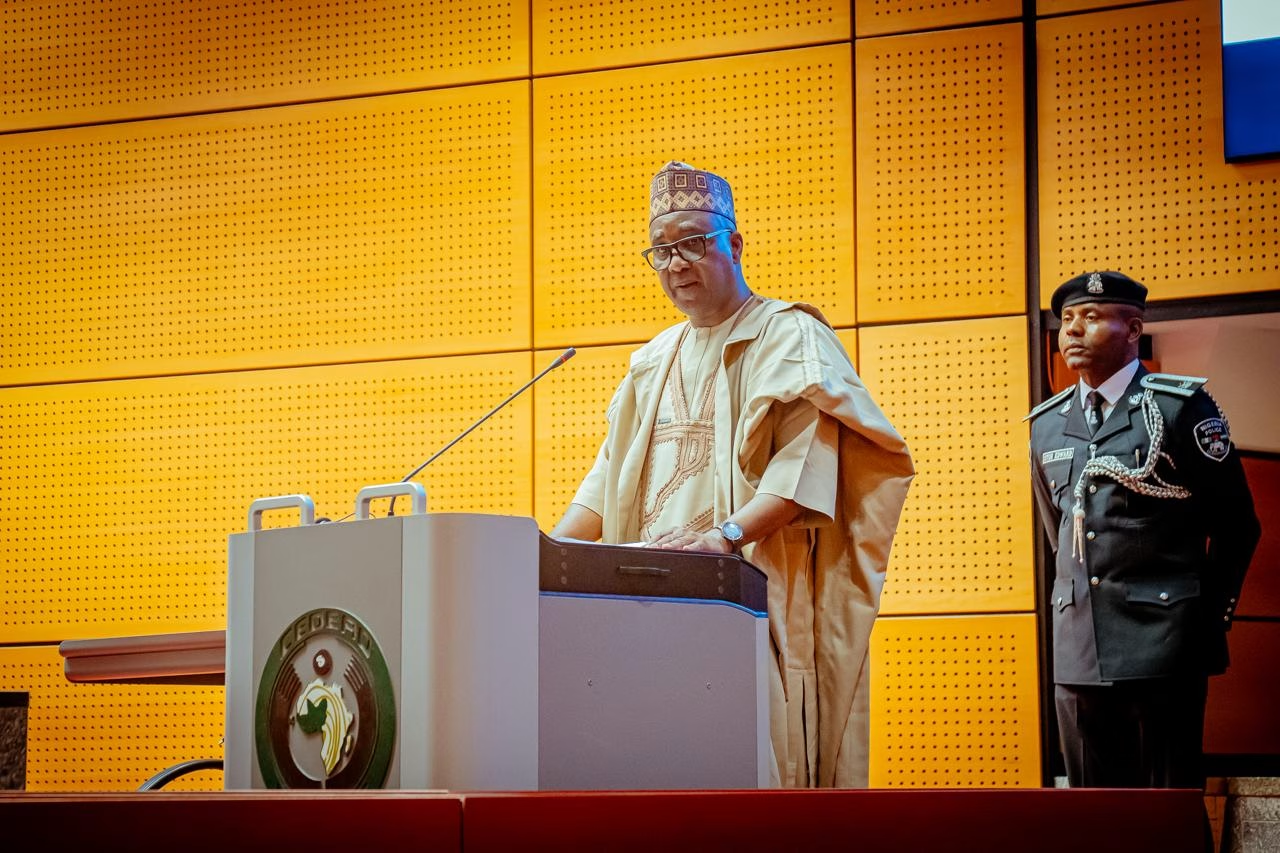

The Speaker of the House of Representatives Rt. Hon. Abbas Tajudeen, has stated that the world is closely watching democracy in West Africa, noting that unconstitutional change of government in the sub-region should cause a direct and measured response.
He stated that evidence has shown that people of the Economic Community of West African States (ECOWAS) are opposed to military rule.
Speaker Abbas said this in his address at the opening ceremony of the 2026 First Ordinary Session of the ECOWAS Parliament (Sixth Legislature) in Abuja on Monday.
The Speaker pointed out that the session brought together parliamentary leaders and representatives from across the sub-region “at a time when the choices before us are both consequential and immediate.”
He said, “Across West Africa, democratic systems are under close examination. The concern is no longer limited to the conduct of elections. It extends to the broader question of whether democratic governance is producing outcomes that citizens can recognise and trust. In several countries within the sub-region, voter participation has declined, and public confidence in institutions has weakened.
“At the same time, we have witnessed a number of unconstitutional changes of government, each of which signals underlying institutional stress. These developments require a direct and measured response. The issue is not whether democracy remains the preferred system of governance. Evidence across the region continues to show that citizens reject military rule.
Speaker Abbas emphasised that “electoral legitimacy must be matched by governance outcomes.” He stressed that security, economic stability, and fairness in public administration “are no longer aspirational goals; they are the basis on which citizens evaluate the state’s credibility. Where these are absent, the space for disruption expands.”
Within this context, the Speaker noted that the role of the ECOWAS Parliament becomes increasingly important, adding that it must function not only as a deliberative body, but as a platform for aligning democratic practice with the expectations of citizens across member states.
He said, “It is important to acknowledge that this question of relevance is not new. Over the years, there have been sustained efforts within the community to strengthen the mandate of the Parliament, including proposals to move it from an advisory body towards one with enhanced legislative authority, greater oversight capacity, and a more direct role in regional decision-making.”
Speaker Abbas emphasised that strengthening the powers, relevance, and operational capacity of the institution is not a procedural ambition but a strategic necessity for regional stability.
“A more empowered Parliament would enhance accountability within the Community, deepen citizen representation at the regional level, and provide a stronger democratic anchor in times of stress,” he stated
While opining that national parliaments are central to this effort, the Speaker said they are the institutions through which laws are made, executive action is scrutinised, and public resources are allocated. He added that their effectiveness determines, in practical terms, how citizens experience governance.
He stated, “Where parliaments are active and responsive, democratic systems are strengthened. Where they are passive, institutional balance is weakened.”
In Nigeria, the Speaker explained that the National Assembly has sought to respond to these responsibilities with a clearer sense of purpose. “Under my leadership, the House of Representatives has prioritised legislative productivity, oversight discipline, and public engagement,” he said.
Speaker Abbas added that mechanisms have been introduced to expand transparency and access, while legislative interventions have been aligned with national priorities in areas such as economic reform, security, and social protection.
He said, “A specific area of focus has been the strengthening of Parliamentary Friendship Groups. These platforms facilitate structured engagement with legislatures in other countries, enabling the exchange of experiences, coordination of positions, and the development of shared approaches to common challenges. Their impact is already visible in improved legislative cooperation and dialogue.
“I wish to make a strong case for institutionalising similar mechanisms across the sub-region to complement the work of the ECOWAS Parliament and reinforce inter-parliamentary collaboration.”
The Speaker had created parliamentary friendship groups for over 40 countries as part of his legislative diplomacy on issues of mutual interest and benefit between Nigeria and other countries.
At the regional level, Speaker Abbas noted that ECOWAS has established frameworks to support these objectives. “The focus now must be on implementation,” he stated, adding that early warning mechanisms, peer review processes, and technical support for member states should be strengthened to ensure that democratic standards are upheld consistently.
The Speaker declared that three priorities follow, including that democratic systems must deliver measurable outcomes, political leadership must uphold accountability, and regional cooperation must translate agreements into sustained action.