


By Ezeh Emmanuel Ezeh, PhD
Whenever I reflect on the social, economic and political condition of Ebonyi State today, I am reminded of the classic film Saving Private Ryan. At its heart, the movie asks a simple but profound question: how much are we willing to sacrifice to ensure that one of our own is not abandoned?
Today, that question is no longer about a soldier stranded on a battlefield. It is about Ebonyi State itself.
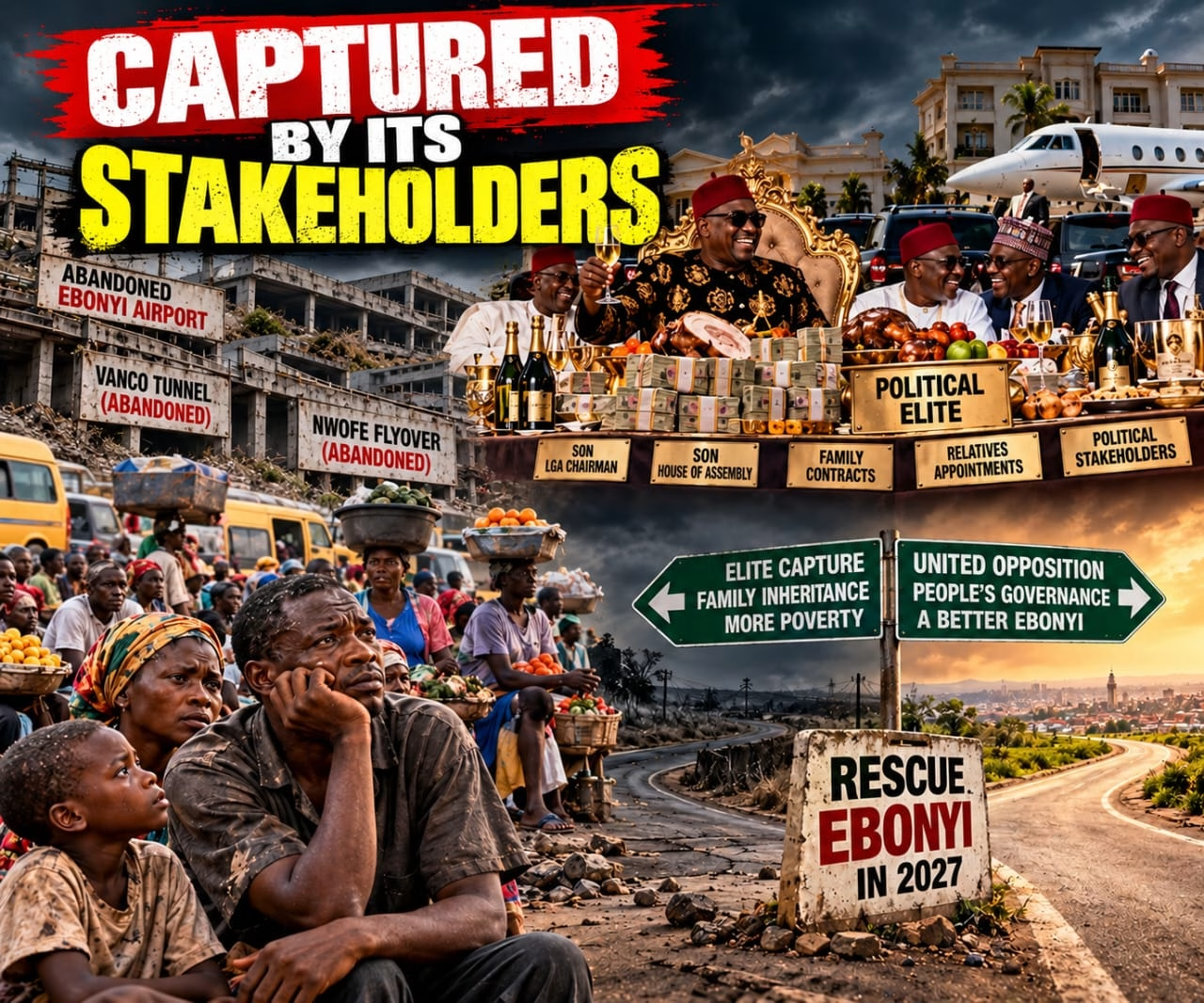
Ebonyi is gradually becoming a state held hostage by a small but very self-serving prebendal political elite that has transformed public office into private property and political power into family inheritance.
A handful of self-appointed “stakeholders” now dominate the levers of power, distribute opportunities among themselves, allocate positions to relatives, and treat the resources of the state as though they were personal assets.
While ordinary citizens struggle under worsening economic conditions, a privileged few continue to prosper from a system designed to serve them rather than the people.
As Spanish Prime Minister Pedro Sánchez aptly warned, “Speed is useless if we are heading in the wrong direction.” Ebonyi State is not merely heading in the wrong direction; it appears determined to speed towards it.
Behind the grand rhetoric of continuity, zoning, empowerment, and political stability lies a disturbing reality. Many of those who loudly parade themselves as stakeholders and defenders of the state are the same individuals who collected public contracts, failed to execute them, and helped create the very crisis they now pretend to solve. They gather at conferences and zoning summits to prescribe remedies for problems of their own making, while accountability remains absent and failure continues to attract rewards.
The result is a state where political offices are shared among a privileged circle, contracts are distributed like akara balls as personal favours, and public institutions increasingly serve elite interests rather than public needs.
A former governor corners a strategic local government chairmanship and hands it to his son, while a former senator secures a House of Assembly position for his own son. These children are already being primed for positions such as deputy governor and deputy speaker as stepping stones to higher office. Other political godfathers allocate party machinery, state institutions, and political offices to family members in a mad dash of sharing and entitlement. What is presented as governance is, in many cases, little more than the management of an elaborate patronage system.
This is why the greatest threat facing Ebonyi today is not an opposition party, another ethnic group, or any external force. The greatest threat is a political establishment that has become too powerful, too comfortable, and too insulated from the consequences of its failures.
The question before Ndi Ebonyi as 2027 approaches is therefore straightforward: will the opposition continue to operate as fragmented camps serving individual ambitions, or will it unite around the higher task of rescuing the state from an entrenched stakeholder class that has mistaken public service for private entitlement?
If Ebonyi is to be saved, the rescue mission will not come from the very people who created the crisis. It must come from a united opposition capable of offering citizens a genuine alternative to the politics of inheritance, patronage, and elite capture.
Only then can Ebonyi begin the difficult journey from political captivity to genuine liberation.
But can we trust many in the opposition, or are they merely an extension of the very forces of darkness holding Ndi Ebonyi down?
Dr Ezeh Emmanuel Ezeh, an Oxford-trained entrepreneur and public affairs commentator, is the Labour Party candidate for Abakaliki/Izzi Federal Constituency. He is a former Deputy President of the South East Chamber of Commerce, Industry, Mines and Agriculture (SECCIMA) and currently serves as President of the Ebonyi Chamber of Commerce, Industry, Mines and Agriculture (EBCCIMA). He wrote this piece from Abuja.