
Constitution review: Speaker Abbas Says National Assembly’ll lobby Executive, State Assemblies’ Conconcurrence ‘Respecfully’

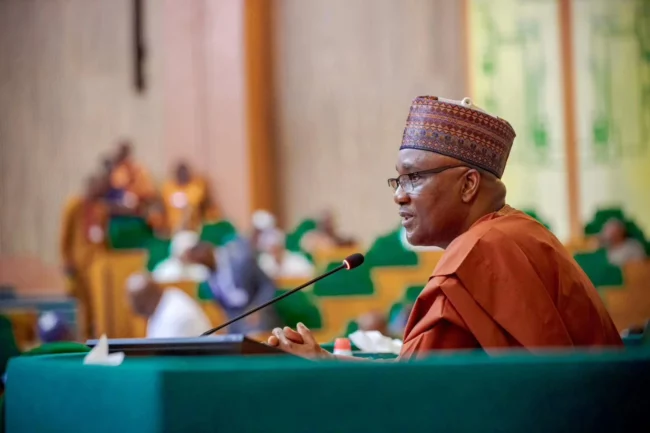

The Speaker of the House of Representatives, Rt. Hon. Abbas Tajudeen, has announced some of the proposed amendments in the ongoing review of the 1999 Constitution by the National Assembly.
One of them is setting a requirement for gender balance when constituting the Federal Executive Council. This is aside from the bill seeking to reserve seats for women in the National Assembly and State Houses of Assembly.
The Speaker made this known at the National Public Hearing on the Review of the 1999 Constitution of the Federal Republic of Nigeria held in Abuja,
Speaker Abbas said there is another bill that seeks inclusion for Persons Living with Disabilities (PLWDs) in politics and governance, as well as constitutional roles for traditional rulers.
He specifically noted that the proposals cover a broad range of themes, reflecting the diversity and complexity of the federation. He also noted that a few of the proposed amendments “are as transformative as those under inclusive governance.”
The Speaker said: “Nigeria cannot prosper by leaving half of its talent and energy on the sidelines. Today women hold less than five percent of seats in the National Assembly. That statistic is unacceptable for a country of our size and ambition.
“The reserved seats for women proposal will create additional seats in the National Assembly and State Assemblies to ensure that every state and senatorial district has women’s voices in lawmaking. This is not tokenism but a constitutional mechanism to accelerate gender inclusion until structural barriers are dismantled.”
He added: “Similar provisions ensure representation for persons with disabilities at the federal, state, and local levels, recognising their right to fully participate in shaping the laws that affect their lives.
“Another amendment requires a minimum threshold of women in ministerial appointments to ensure gender balance. These measures will make our democracy more representative, our policies more responsive, and our country more just.”
Speaker Abbas disclosed that recognition of traditional institutions in the Constitution “is another important proposal,” saying that “our traditional rulers are stabilisers in their communities, mediators in conflict, and custodians of culture.”
He stressed that “by assigning them a defined advisory and functional role, particularly in local peace-building and community security collaboration,” the nation will “integrate their strengths into our democratic framework without undermining republican principles.”
The Speaker stated: “This approach acknowledges Nigeria’s cultural realities and leverages them to foster national unity and stability.”
Announcing that many of the proposals before the National Assembly “perfectly correspond with President Tinubu’s Renewed Hope Agenda, which prioritises security, economic revitalisation, inclusivity, and transparent governance,” Speaker Abbas declared that the constitutional reform will “provide the legal chassis on which that Agenda can be driven forward.”
He said: “The work before us is weighty but inspiring. Constitutions are not perfect documents, but they are powerful compacts. By improving ours, we write a new chapter in our national story.
“Decades from now, when future generations look back at the amendments of 2025, let them say that this generation rose above division and complacency, and dared to renew Nigeria’s promise.
“Let it be remembered that we chose courage over caution, unity over discord, and posterity over short-term politics. Let it be said that we acted not only as legislators or advocates, but as custodians of Nigeria’s destiny.”
While stating that the hearing “marks a significant moment in our democratic journey and legislative process,” the Speaker said it crowns months of deliberate, nationwide engagements “designed to ensure that Nigerians themselves shape the evolution of our supreme law.”
He said under the “capable leadership” of the Deputy Speaker, Rt. Hon. Benjamin Okezie Kalu, as the Chairman, the Committee on Constitution Review had travelled across all six geopolitical zones, convening zonal and regional hearings “that gathered the hopes, concerns, and insights of our diverse population.”
Speaker Abbas noted: “In those engagements, Nigerians from every background spoke with clarity and passion about the future they seek. Today’s forum unites those regional voices in a single, national conversation. It reflects the House of Representatives’ steadfast commitment to participatory governance and inclusive nation-building, affirming that every Nigerian has a meaningful voice in shaping the document that defines our republic.”
The Speaker pointed out that from the outset of the review, the House had pledged that it would conclude the process on time. “Nigerians are weary of constitutional reforms that drag on for years, losing momentum and eroding public trust,” he said.
He said: “We recognise that, after the National Assembly votes on these bills, the State Houses of Assembly must also consider and approve them under Section 9 of the Constitution.
“To honour this requirement, we have set clear timelines. We intend to vote on the proposals expeditiously and to transmit them promptly to the State Houses of Assembly so that concurrence can be secured within the current legislative session.
“Reform delayed is reform denied, and Nigerians deserve clarity and closure. By acting decisively, we give the States enough time to debate, deliberate, and endorse the people’s will without the pressure of electoral calendars or political distractions.”
Speaker Abbas called on all the stakeholders at the hearing, including civil society organisations, professional bodies, labour unions, traditional rulers, political parties, youth and women’s groups, the media, and every citizen, to engage robustly and constructively in this hearing.
“Present your positions with clarity and patriotism. Offer solutions where you see challenges. Ask questions where you seek clarification. Even after today, continue to educate your communities, brief your State Assemblies, and hold us accountable. Constitutional reform is a process that relies on your vigilance and participation,” he said.
The Speaker, however, emphasised the critical roles that State Houses of Assembly play in constitutional amendment.
He said: “As Speaker, I pledge that we will take your contributions seriously and consider the bills with diligence, fairness, and urgency. We will engage the State Assemblies respectfully and transparently to secure their concurrence. We will continue to work with the Executive and with you, the people, to ensure that the amendment process proceeds smoothly.”He