

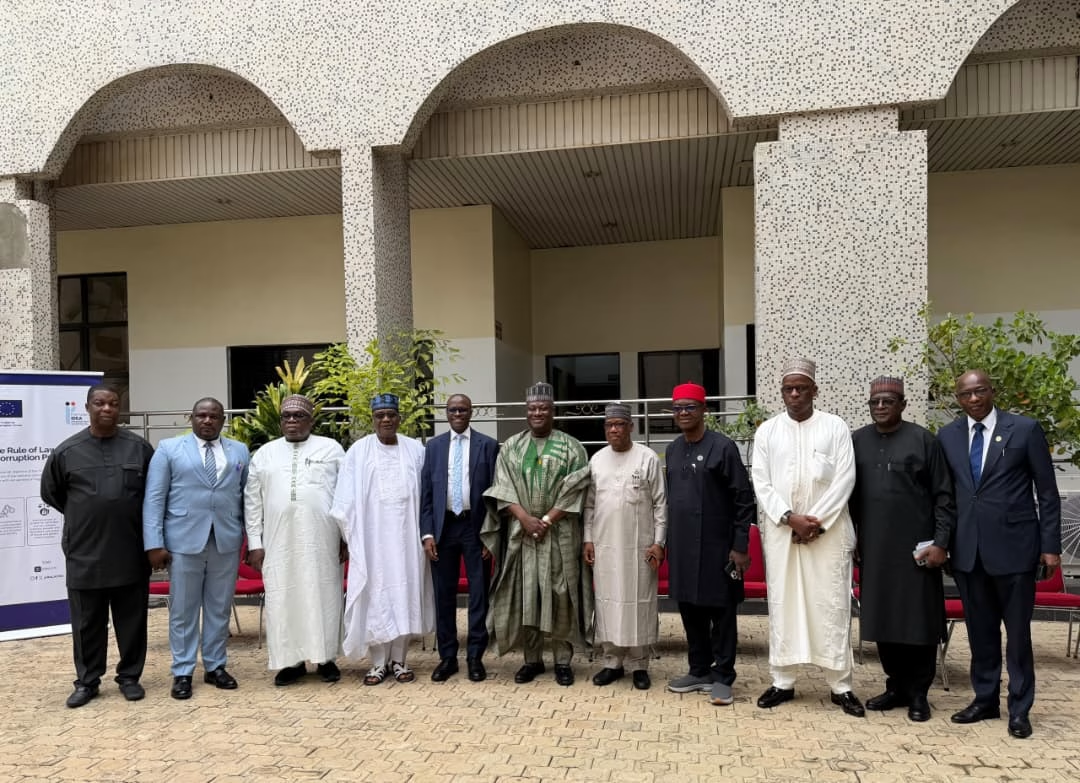

The Chairman of the Independent Corrupt Practices and Other Related Offences Commission (ICPC), Dr Musa Adamu Aliyu, SAN, has charged Ministries, Departments and Agencies (MDAs) underperforming on the Ethics and Integrity Compliance Scorecard (EICS) to learn from institutions that have demonstrated strong commitment to ethical standards, transparency and accountability.
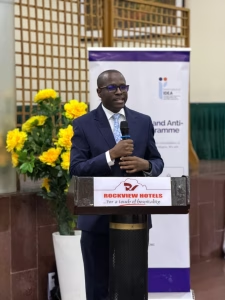
Dr. Aliyu gave the charge on Tuesday in Abuja at the One-Day Peer Review Roundtable with Performing and Non-Performing MDAs’ Chief Executives on their Annual Ethics and Integrity Compliance Scorecard, organised by the ICPC in collaboration with the Rule of Law and Anti-Corruption (RoLAC) Programme.
He said the Roundtable was designed to promote peer learning and enable institutions to share practical experiences on strengthening ethics and integrity systems across the public service.
“The MDAs being celebrated today as strong performers on the EICS are proof that the Scorecard works when it is taken seriously; and for MDAs still finding their footing, today’s roundtable is designed exactly for you as a chance to learn from those who are getting it right,” he said.
The Chairman explained that the EICS is one of the Commission’s preventive tools for assessing MDAs’ compliance with ethics, statutes, policies and standards that promote transparency and accountability.
He said the Scorecard measures institutional performance across Management Culture and Structure, Financial Management System, Administrative System, and Anti-Corruption and Transparency Unit (ACTU), while encouraging healthy competition among public institutions.
Dr. Aliyu also underscored the importance of ACTUs, describing them as in-house ethics champions that promote expected standards, provide channels for reporting concerns, monitor expenditure and review internal processes for corruption vulnerabilities.
He noted that ACTUs perform more effectively when they receive the necessary support and commitment from the leadership of their organisations.
While congratulating high-performing MDAs, the Chairman urged underperforming institutions to regard their scores not as a source of embarrassment but as an opportunity for improvement.
“To those still working towards it, please do not see today as a scorecard of shame, but as an honest starting point and an invitation to learn from your colleagues in the room,” he said.
In his goodwill message, the Component Lead of the RoLAC Programme, Dr. Emmanuel Uche, commended the ICPC Chairman for strengthening institutional processes and sustaining reforms initiated by his predecessors.
He said the EICS demonstrates the Commission’s commitment to helping MDAs identify systemic weaknesses, administrative lapses and procedural loopholes that could enable corruption, urging underperforming institutions to learn from the systems and practices of high-performing MDAs.
In his keynote address, the Secretary to the Government of the Federation, Senator George Akume, represented by the Permanent Secretary, General Services Office, Dr. Ibrahim Abubakar Kana, urged public sector chief executives to build resilient institutions capable of withstanding leadership changes, political pressures and economic shocks.
Presenting a paper titled, “The Public Executive: Building Resilient Institutions Beyond Political Tenure,” Kana warned that weak institutional systems contribute to policy discontinuity, organisational instability, loss of institutional knowledge and the abandonment of valuable reforms.
Kana identified clarity of purpose, knowledge management, institutional memory, integrity and ethical leadership as critical pillars of resilient public institutions. He stressed the Federal Government’s zero tolerance for corruption and non-compliance and called for stronger collaboration among MDAs and engagement with citizens, academia, civil society and the private sector.
He further challenged public servants to regard themselves as trustees of institutions for future generations, noting that they would ultimately be judged not merely by the offices they occupied, but by “the institutions we strengthened, the systems we improved, the values we upheld and the foundations we laid for future generations.”