

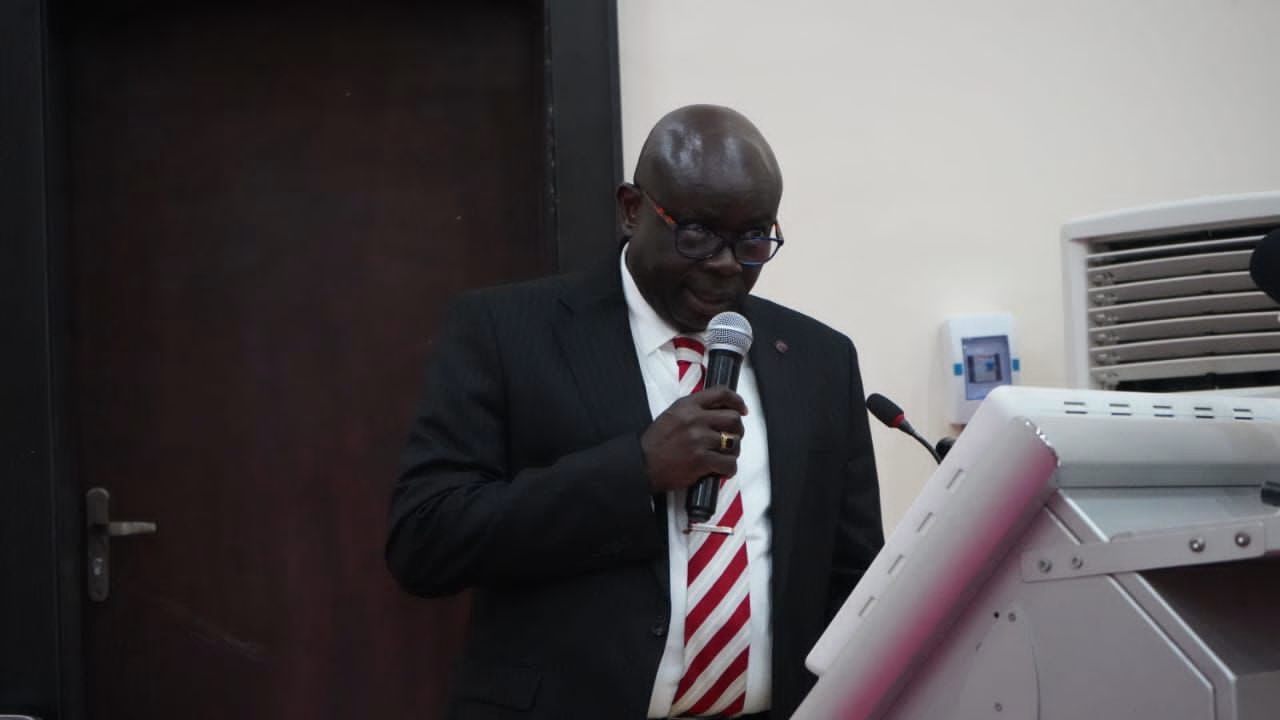

The Chairman of the Independent Corrupt Practices and Other Related Offences Commission (ICPC), Dr. Musa Adamu Aliyu, SAN, has called on Nigerian law students to embrace integrity as the foundation of their professional lives, urging them to become the next generation of anti-corruption advocates committed to advancing justice and national development.
Dr. Aliyu made the call while delivering the keynote address at the Dean’s Parley of the Faculty of Law, Yakubu Gowon University, Abuja, on Wednesday, July 30, 2026. Speaking on the theme, “Raising the Next Generation of Anti-Corruption Advocates in Nigeria,” the ICPC Chairman challenged students and academics to reflect on how the legal profession can produce lawyers who embody integrity rather than merely excel in advocacy.
Describing corruption as a global phenomenon, Dr. Aliyu noted that while no society is entirely free from corruption, countries that successfully reduce it are better positioned to achieve sustainable development. Citing the work of renowned anti-corruption scholar Robert Klitgaard, he observed that corruption, like pollution or disease, exists in varying degrees and can be significantly reduced through strong institutions and ethical leadership.
He explained that corruption discourages investment, weakens public institutions, distorts resource allocation, erodes public trust and undermines human development. Referencing findings from the 2025–2026 Commonwealth Africa Anti-Corruption Centre survey conducted across fourteen African countries, he noted that a majority of respondents identified corruption as a major impediment to development, citing poor infrastructure, rising living costs and declining public confidence in government. The survey also identified greed and the absence of integrity as the principal drivers of corruption.
To illustrate the consequences of corruption, the ICPC Chairman cited the Supreme Court judgment in Yakubu v. FRN, involving the diversion of billions of naira from the Nigerian Police Pension Fund. Quoting Justice Tijjani Abubakar, JSC, he reiterated the Court’s position that public officers who loot public resources must never be allowed to believe that corruption is rewarding or acceptable.
He also referenced the December 2025 judgment of the Federal High Court, Abuja, which ordered the permanent forfeiture of land earmarked for the Goodluck Jonathan Legacy Model Housing Estate under the National Housing Fund Scheme. Despite the reported disbursement of approximately 65 million dollars by the Federal Mortgage Bank of Nigeria for the construction of 962 housing units, the project was abandoned without a single house completed. The Court subsequently directed the ICPC to oversee the completion of the estate for the benefit of its intended beneficiaries.
According to Dr. Aliyu, these cases demonstrate that corruption imposes enormous development, institutional and generational costs on the nation by depriving citizens of essential services, weakening public institutions and denying young Nigerians opportunities for a better future.
Addressing the students directly, he reminded them that legal knowledge is morally neutral and can either be deployed to protect wrongdoing or to promote justice, depending on the choices made by those who possess it. He encouraged them to become lawyers whose careers would be defined by integrity, competence and moral courage.
The ICPC Chairman also charged law lecturers to recognise their responsibility in shaping not only the intellectual capacity of future lawyers but also their ethical values, stressing that character formation is as important as academic excellence.
Highlighting the Commission’s preventive mandate, Dr. Aliyu outlined ongoing initiatives aimed at promoting integrity among young Nigerians, including public enlightenment programmes and the institutionalisation of anti-corruption education in partnership with the Nigerian Law School under the National Anti-Corruption Strategy.
He urged the students not to be discouraged by perceptions that success in Nigeria depends on connections rather than merit, encouraging them instead to reject examination malpractice, bribery and every form of dishonesty. According to him, lasting national transformation begins with the simple but consistent choice to do what is right.
In his remarks, the Vice-Chancellor of Yakubu Gowon University, Professor Hakeem Babatunde observed that corruption within tertiary institutions manifests in various forms, including cultism, sexual harassment, plagiarism and examination malpractice. He encouraged students to report such misconduct through the University’s open-door policy and expressed optimism that Dr. Aliyu would return to the institution as a visiting scholar.
Earlier, the Deputy Vice-Chancellor, Professor Muhammad Umaru Ndagi, welcomed participants and commended the ICPC Chairman’s commitment to promoting ethical leadership among students, noting that education extends beyond academic achievement to character development.
Also speaking, the Dean of the Faculty of Law, Professor Uwakwe Abugu, welcomed the keynote speaker and participants, stressing the need to prepare future legal professionals to confront the ethical and governance challenges facing the nation.