
‘Biko,’ ‘Nyash,’ ‘Abeg,’ ‘Ghana Must Go,’ ‘Amala’ Among New Words Added to Oxford English Dictionary


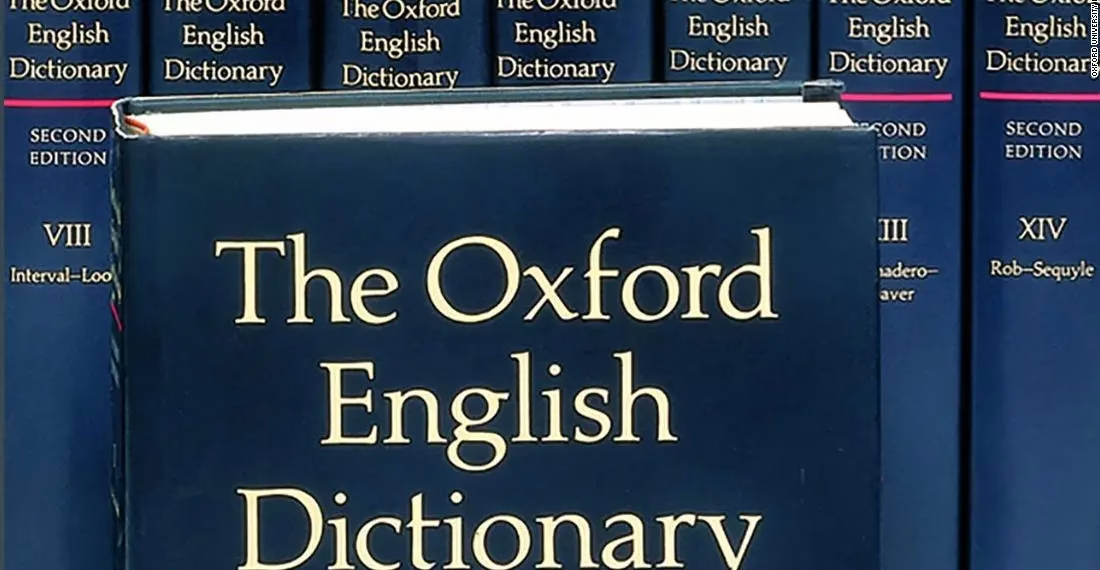
The Oxford English Dictionary (OED) has again added several new words from across the world, including words and slangs of Nigerian-origin.
The neologisms are part of the latest updates to the ever dynamic and constantly expanding English vocabulary which has firmly established itself as the language of the world.
In the December 2025 update released on Wednesday, some Nigerian popular words and slang like, “biko,” “Nyash,” “abeg”,” “moi moi” and “Ghana Must Go” were among the new words.
The new update features more than 500 new words, phrases and senses, including internet slang such as “DM”, “brainfart” and “chug”.
Over 1,000 existing entries were also revised, while editors explored the histories of words such as “troll”, “coffee” and “snooker”.
The update includes additions from varieties of English used around the world, including West African English, Maltese English, Japanese English and South Korean English, with OED editors noting the growing global influence of these Englishes
mong the Nigerian entries are everyday expressions and food items, including “nyash,” “mammy market,” “amala,” “moi moi,” “abeg,” “biko,” and “Ghana Must Go.”
The update included “Afrobeats”, defined as “a style of popular music incorporating elements of West African music and of jazz, soul, and funk.”
The dictionary describes “abeg” as an interjection used to express contextually a range of emotions, such as surprise, exasperation, disbelief
Biko”, originally from the Igbo language, is defined as an adverb and interjection used in polite request or agreement, or to add polite emphasis or urgency: ‘please’.

Nyash” is defined as “a person’s (esp. a woman’s) buttocks; the bottom, the backside.”
Also added is “Ghana Must Go”, the popular name for the large, chequered plastic bags widely used in West Africa, whose expression traces back to the 1983 mass expulsion of undocumented Ghanaian migrants from Nigeria.
It is defined as “A large, zippered bag made of durable plastic with a colourful check pattern, often used for carrying one’s…”
The term “mammy market” was recognised as “a market typically run by women, originally found in military barracks but later also in youth service camps and educational institutions.”
In the category of cuisine, the dictionary included “amala”, a staple food made from yam or cassava flour, defined as “a kind of dough made of yam, cassava, or unripe plantain flour, typically formed into a ball and served as an accompaniment to other dishes” and “moi moi”, a dish originating among the Yoruba people, “consisting of beans ground into a smooth paste, mixed with peppers, onions, dried…”
The Oxford English Dictionary expanded its lexicon with 20 Nigerian words and expressions in a January 2025 update, highlighting the influence of Nigerian English, Pidgin and street slang on global vocabulary
he additions included everyday terms such as japa, agbero, eba, a staple food made from cassava flour.
Other entries such as 419, referring to internet fraud, and abi, a common conversational tag, also made
Below is the full list:
- abeg, int. & adv.: “Used to express contextually a range of emotions, such as surprise, exasperation, disbelief, etc.”
- abrokyire, n.: “The world outside Ghana; foreign or overseas countries, esp. those which are developed and wealthy. Also as a modifier.”
- Adowa, n.: “A traditional dance style originating among the Akan people of Ghana, Ivory Coast, and Togo, typically accompanied by drumming and performed at…”
- Afrobeats, n.: “Originally: a style of popular music incorporating elements of West African music and of jazz, soul, and funk; = Afrobeat, n.; (also) pieces of music…”
- Afrophobia, n.: “Fear of or prejudice against Africa or African people; (more generally) fear or intense dislike of, or prejudice against, black people.”
- ajumma, n.: “In Korea and in Korean contexts: a middle-aged or older woman, esp. one who is married. Also used as a form of address.”
- aljotta, n.: “A traditional Maltese soup made with small fish typically left whole, garlic, onions, tomatoes, marjoram, mint, and rice.”
- amala, n.: “In Nigerian cookery: a kind of dough made of yam, cassava, or unripe plantain flour, typically formed into a ball and served as an accompaniment to other dishes.”
- ampesi, n.: “In Ghanaian cookery: a dish consisting of chopped cocoyam, plantain, yam, or other starchy tubers, boiled together and typically served with a stew…”
- approval rating, n.: “Originally: an official endorsement or indication of satisfaction or acceptance. In later use: a measurement of the extent to which a person or thing…”
- bajillion, n. & adj.: “A very large (but indefinite) number or quantity (of something); chiefly in plural.”
- benachin, n.: “A Senegalese and Gambian dish of rice, tomatoes, onions, chillies, and sometimes meat or other vegetables, cooked in one pot. Cf. jollof, n.”
- bichir, n.: “Any of several freshwater African fishes constituting the genus Polypterus (family Polypteridae), having an elongated body covered in ganoid scales…”
- bigilla, n.: “A traditional Maltese dish of mashed broad beans, olive oil, garlic, and red pepper, typically served as a dip or spread.”
- biko, adv. & int.: “Used in polite request or agreement, or to add polite emphasis or urgency: ‘please’.”
- bingsu, n.: “A Korean dessert of shaved ice with various sweet toppings such as condensed milk, red beans, chopped fruit, fruit syrup, etc.”
- biobanking, n.: “The storage and management of biological material; spec. (a) the storage of (chiefly human) biological samples for research or clinical purposes; (b)…”
- boss eye, n.: “Now usually regarded as offensive. An eye that appears to be out of alignment or is otherwise impaired, injured, or unable to focus. Frequently in plural.”
- bossa, n.: “A style of Brazilian music derived from samba; = bossa nova, n. Also: a song or piece of music of this type. Frequently as a modifier; spec…”
- bossed, adj.²: “Overseen, managed. Also (frequently with around, about): ordered around in a domineering manner.”
- bossie, n.: “A small bush or shrub.”
- bossies, adj.: “Of a person: displaying thinking or behaviour considered to be irrational, inappropriate, or dissociated from reality (originally spec. as a symptom…”
- bossless, adj.: “Without a person in charge; having no boss or leader. In later use chiefly spec.: (of a business or organization) having a chain of command which is…”
- bovinity, n.: “Behaviour or qualities regarded as characteristic of oxen, cows, or similar animals; esp. docility, slowness, or lack of intelligence. Cf. bovine, adj. A.1.”
- brain fart, n.: “colloquial. A temporary mental lapse or failure to reason correctly; a momentary loss of memory or concentration.”
- break-action, adj. & n.: “Designating a type of firearm having a hinged barrel or barrels which can be opened to expose the breech, allowing the user to load new ammunition or…”
- brush pen, n.: “Originally: a paintbrush used in East Asia for writing and painting with ink. Later also (now chiefly): a pen with an ink cartridge and a nib of…”
- cell-cultivated, adj.: “Originally: designating a pathogen propagated in cultured cells in a laboratory. In later use also: designating a substitute for meat, poultry, or…”
- cell-cultured, adj.: “Originally: designating a pathogen propagated in cultured cells in a laboratory, or a vaccine made from these pathogens. In later use also…”
- ceramide, n.: “Any of a class of lipids which are major components of cell membranes and of the extracellular substance of the stratum corneum of the skin and the…”
- check bit, n.: “A bit used to control a horse; spec. one used in combination with a check rein to control the movement of the horse’s head. Also (and in earliest…”
- check line, n.: “Surveying. A line measured on the ground, which, while not geometrically necessary, serves to test the accuracy of the principal measurements and…”
- check mark, n.: “A mark (now usually ✓) made against an item in an account, list, text, etc., typically used to indicate that something is correct or has been chosen…”
- check-out, n.¹: “A withdrawal by cheque from a bank account. Cf. cheque, v. 2.”
- check over, n.: “The action or an act of checking something over (cf. to check over); an examination or inspection of a person or thing.”
- check-raise, n.: “The action or fact of passing betting to the next player during a round of betting without making a bet oneself (see sense check, v.¹ II.13), before…”
- check-raise, v.: “intransitive. During a round of betting: to pass betting to the next player without making a bet oneself (see check, v.¹ II.13), before making a…”
- check ride, n.: “A flight taken by a pilot following training, during which an examiner evaluates his or her ability to carry out the manoeuvres and processes…”
- check swing, n.: “Baseball and Softball. A swing of the bat which the batter halts part way through with the aim of allowing the ball to pass by, esp. which the umpire…”
- checkboard, n.: “A board for playing draughts (checkers), chess, and similar games, having a regular pattern of 64 squares in alternating colours, typically black and…”
- checkdown, n.: “American Football. A short pass made by a quarterback to a running back, tight end, or other eligible player as a last resort when the primary…”
- checked swing, n.: “A swing of the bat which the batter halts part way through with the aim of allowing the ball to pass by, esp. which the umpire rules to have fallen…”
- checkerspot, n.: “Any of various North American nymphalid butterflies, esp. in the genus Euphydryas, that have a chequered pattern of wing markings. More fully…”
- checkmark, v.: “transitive. To mark (something, esp. an item in an account, list, text, etc.) in some way (now usually with a ✓), typically to indicate that it is…”
- checkmated, adj.: “Chess. Of a king: that has been put in checkmate; (of a player) that has been defeated in this way. Hence more generally: that has been placed in a…”
- checkside, adj. & n.: “Australian Rules Football. Chiefly in South Australia. Of a kick at goal: made at a tight angle from the side of the goalposts, and causing the ball…”
- checkweigh, v.: “transitive. Originally (of a checkweigher in a colliery): to check the weight of (the coal sent up from a mine) in order to ensure that the miners…”
- chequerboard | checkerboard, v.: “transitive. To divide or arrange (something) into a pattern resembling a chequerboard. Also: to mark (something) with such a pattern.”
- chequing | checking, n.: “Frequently with out. The action or process of withdrawing money from a bank (originally by cheque, later also via other methods of withdrawal).”
- chugging, adj.: “That chugs (in various senses); esp. that makes a plunging, pumping, or dull explosive sound, such as that of the stroke of a slow engine…”
- civet coffee, n.: “Coffee made from coffee cherries which have fermented while passing through the digestive tract of a civet. Cf. kopi luwak, n.”
- coat-tail, v.: “transitive. Originally and chiefly Politics (often disparaging). To (seek to) benefit from the prior achievements or efforts of (a person or thing)…”
- coater, n.: “A person who, or (in later use esp.) tool or machine which, applies a coating or coatings of paint, varnish, etc.”
- coatigan, n.: “A type of cardigan, now a long cardigan typically worn by women, which is made of thick yarn and worn as an outer layer.”
- coating, adj.: “That coats something; that constitutes or forms a coating.”
- coatmaker, n.: “A person who makes coats or jackets, esp. as a profession. Also: a company that specializes in making coats.”
- coffee boy, n.: “A male servant, waiter, or assistant who makes or serves coffee.”
- coffee can, n.: “A metal container used for brewing coffee. Also: a container used for storing ground coffee or coffee beans.”
- coffee date, n.: “An arrangement to meet a person for coffee or in a café, esp. a friend; (also) a casual, often initial meeting with a person one has a romantic interest in.”
- coffee money, n.: “Money that can be used to buy coffee; (more generally) a small or trivial amount of money.”
- coffee pod, n.: “A receptacle, typically made of plastic or aluminium, containing pre-prepared ground or concentrated coffee that is used to make a single serving of…”
- coffee ring, n.: “A brown, ring-shaped stain (esp. on paper, furniture, etc.) caused by coffee that has collected on the underside of a coffee mug, cup, or its saucer.”
- crash bang wallop, int., adj., & n.: “Representing or suggesting a succession of loud noises or blows. Also figurative: indicating the occurrence of a quick, sudden, or surprising event…”
- crash bang, int., adj., & n.: “Representing the sound (or successive sounds) made by a collision, crash, or sudden impact, or by something being smashed.”
- crash box, n.: “A structure or component within a motor vehicle designed to absorb some of the energy of a collision or other impact by undergoing controlled…”
- crash hot, adj.: “Excellent, great, fantastic.”
- crash-proof, adj.: “Esp. of a vehicle or part of a vehicle: designed or adapted to be resistant to the damaging effects of a collision; capable of withstanding the impact of a crash.”
- crash tackle, n.: “A tackle in which a player collides with an opponent heavily enough or with sufficient impact to stop all forward momentum, or force him or her…”
- crash team, n.: “Medicine. colloquial. A team of medical professionals in a hospital that responds rapidly to medical emergencies, esp. in performing resuscitation in…”
- crash test, n.: “A test in which a vehicle is crashed under controlled conditions; spec. a vehicle safety test in which crashes, collisions, etc., are studied in a…”
- crash test, v.: “transitive. To crash (a vehicle) under controlled conditions; spec. to run a safety test on (a vehicle or part of a vehicle) in which crashes…”
- crash testing, n.: “The action or process of carrying out a crash test or tests.”
- crashed, adj.: “Of a vehicle: damaged as a result of colliding violently with something; that has been in a crash. Cf. crash, v. I.6a.”
- crashingly, adv.: “colloquial. As an intensifier: very, extremely; excessively; overwhelmingly.”
- creative juices, n.: “Creativity, inspiration, or imagination. Esp. in to get one’s creative juices flowing (and variants): to start thinking in an imaginative or inventive way.”
- cross-bat, v.: “transitive. To play (a delivery) with the bat held in a more or less horizontal position and swung across the line of the ball. Usually with…”
- cross-battery, adj.: “Of or relating to an approach to educational or psychological assessment in which a variety of tests or examinations (used to measure ability…”
- cross-batting, n.: “The action of playing strokes with the bat held in a more or less horizontal position and swung across the line of the ball.”
- cross bike, n.: “A bicycle designed for cross-country racing which combines features of a road bike and a mountain bike, and is suitable for riding over a variety of…”
- cross-cast, v.: “Theatre. transitive. To assign (an actor) a role that is significantly different to his or her usual parts, or in which the character’s attributes…”
- cross-casting, n.: “Theatre. The practice or an act of assigning an actor the role of a character that is significantly different to his or her usual parts, or whose…”
- cross-city, adj.: “Involving or covering the whole of a city; spec. (of train, bus, etc.) that runs across a city.”
- cross-compiler, n.: “A compiler used to generate machine code for a type of system other than that on which it is being used.”
- cross-connect, n.: “Something that forms, or that is used to make, a physical connection between two or more circuits, networks, systems, etc.”
- cross contact, n.: “spec. Contact between substances or objects, resulting in transfer of a contaminant (esp. an allergen in food) from one to another. Cf. cross-contamination, n.”
- cross-correlate, v.: “transitive. To examine the mutual relationship between measurements, observations, etc., that represent (one thing) and those that represent another…”
- cross-curricular, adj.: “Involving or relating to the study of more than one educational subject; bringing together two or more areas of study.”
- cross-cutting, adj.: “That applies generally across different, typically separate or independent, groups, viewpoints, disciplines, etc. Cf. to cut across.”
- cross-dressing, adj.: “That wears clothing conventionally associated with the opposite sex.”
- cross-examining, n.: “The action of cross-examining someone or something.”
- cross-fall, n.: “A transverse downward slope on a surface or area of ground; spec. one given to a road or paved area in order to allow drainage. Also: the gradient of such a slope.”
- cross-field, adj.: “Of a pass, shot, etc.: made from one side of the pitch to the other.”
- cross file, v.: “transitive. To file (an edge or surface) by holding the file at a right angle to the edge or surface and moving sideways across it; to file the edge…”
- cross-fingering, n.: “Originally: the playing of a musical instrument, esp. with a crossing of the wrists or hands. Later (on a woodwind instrument): a method or the…”
- cross-flow, adj.: “In an internal combustion engine: designating a type of cylinder head having air intake ports on the opposite side of the head from the exhaust…”
- cross-foster, v.: “transitive. To place (a young animal or child) to be reared or raised by an adult that is not its biological parent, often one belonging to a…”
- cross-fostered, adj.: “Designating offspring that have been raised by a parent other than their biological parent (often one belonging to a different group or species, or…”
- cross-fostering, n.: “The placing of a young animal or child to be reared or raised by an adult that is not its biological parent, often one belonging to a different group…”
- cross fracture, n.: “A fracture which is transverse to the principal axis or longest dimension of a rock stratum, crystal, bone, etc.”
- cross-functional, adj.: “Consisting of or involving multiple different departments of a business or other organization.”
- cross-garters, n.: “Garters or ribbons that are tied so as to cross over the wearer’s legs.”
- cross harrow, v.: “transitive. To draw a harrow over (a piece of land) for a second or subsequent time, transversely across the existing furrows, in order to improve…”
- cross harrowing, n.: “The action or process of drawing a harrow over a piece of land for a second or subsequent time, transversely across the existing furrows, in order to…”
- cross-holding, n.: “The ownership by two or more companies of a portion of each other’s shares or other assets; an instance of this; (in plural) holdings owned in this…”
- cross-ice, adj.: “Designating a pass played from one side of the ice to the other.”
- cross index, n.: “A reference system, esp. an index (index, n. 5) in a book or document, containing notes that cross-refer to and provide the location details of…”
- cross-indexed, adj.: “Of an entry in a book or document: that is annotated with a cross-reference to another item. Also of a book or document: featuring or consisting of…”
- cross-infection, n.: “The transmission of an infectious agent or disease between individual people, animals, or plants, or between different species; esp. the transmission…”
- cross-interrogation, n.: “Cross-questioning, cross-examination; an instance or period of this.”
- cross lease, n.: “A type of contract by which a property or area of land consisting of multiple units is held in joint ownership, with each party leasing their unit…”
- cross-lease, v.: “transitive. To place (a property or area of land consisting of multiple units) under joint ownership, with each party leasing their unit from the group.”
- cross-leased, adj.: “Of a property or area of land consisting of multiple units: placed under joint ownership, with each party leasing their unit from the group.”
- cross-linguistically, adv.: “Across different languages; spec. across all languages.”
- cross-linker, n.: “A molecule, substance, etc., which acts to form cross-linkages.”
- cross-lit, adj.: “That has been illuminated by a cross-light or cross-lights. Cf. cross-light, n. 1.”
- cross-ownership, n.: “The ownership by two or more companies of a portion of each other’s shares or other assets; an instance of this. Cf. cross-holding, n.”
- cross polarization, n.: “Polarization in which an electromagnetic wave is polarized along a plane or axis that is orthogonal to that of another electromagnetic wave. Also: a…”
- cross-post, v.¹: “transitive. Originally: to transfer (a soldier) to a new regiment or location. Later also: to move (an employee) to a new department, place of work…”
- cross-post, v.²: “transitive and intransitive. To post (a message) to more than one newsgroup, forum, etc., on a network; (in later use chiefly) to post or share…”
- cross-posting, n.¹: “Originally: the transfer of a soldier to a new regiment or location. Later also: the movement of an employee or worker to a new job, department, place of work, etc.”
- cross-posting, n.²: “The action or practice of posting a message to more than one newsgroup, forum, etc., on a network; (in later use chiefly) the action or practice of…”
- cross-pressure, n.: “Political, social, or economic influence that conflicts with a person or institution’s existing motivations. Also as a count noun.”
- cross-pressure, v.: “transitive. To subject (a person) to conflicting political, social, or economic influences, or to an influence that is contrary to their existing…”
- cross-pressured, adj.: “Of a person or institution: subjected to conflicting political, social, or economic influences, or to an influence that is contrary to their existing…”
- cross-promote, v.: “transitive. To use one product, service, etc., to promote (another product, service, etc.). Also of a product, service, etc.: to promote (another…”
- cross-promotion, n.: “The use of one product, service, etc., to promote another. Also (and in earliest use): an instance of this. Cf. cross-promote, v.”
- cross-rate, n.: “An exchange rate between two currencies computed by reference to a third currency, now usually the U.S. dollar.”
- cross-react, v.: “intransitive. Of an antibody or an antiserum, culture, etc., containing antibodies: to react with an antigen which differs from the one that…”
- cross-reacting, adj.: “Of an antibody or an antiserum, culture, etc., containing antibodies: that reacts with an antigen which differs from the one that originally gave…”
- cross-reaction, n.: “Immunology. A reaction between an antibody and an antigen (or an antiserum, culture, etc., containing them) in which the antigen differs from the one…”
- cross-reactive, adj.: “Of an antibody or an antiserum, culture, etc., containing antibodies: that reacts with an antigen which differs from the one that originally gave…”
- cross-reactivity, n.: “The reaction between an antibody and an antigen (or an antiserum, culture, etc., containing them) in which the antigen differs from the one that…”
- cross-read, v.: “transitive. To read or study (something, esp. a literary text), typically closely, by comparing it with something else, etc.; to read, study, or…”
- cross-sex, n. & adj.: “Of, belonging to, or associated with the other sex; passed or transferred from a member of one sex to a member of the other.”
- cross-shareholding, n.: “The ownership by two or more companies of a portion of each other’s shares; a shareholding of this nature. Cf. cross-holding, n.”
- cross-site scripting, n.: “A means of carrying out a cyber-attack in which a script is inserted into a website and executed by another user’s web browser, allowing the attacker…”
- cross slide, n.: “In a lathe or planing machine: a sliding part, on which the cutting tool is mounted, which allows the tool to be precisely positioned at right angles…”
- cross-strait, adj.: “That exists or operates across a strait; designating a relationship, interaction, etc., between areas on either side of a strait. Now chiefly spec…”
- cross-subsidization, n.: “The action or practice of subsidizing an activity or area of business out of the profits of another activity or area of business; (often) spec. the…”
- cross-subsidize, v.: “transitive. To subsidize (an activity or area of business) out of the profits of another activity or area of business; (often) spec. to decrease the…”
- cross-subsidy, n.: “A subsidy granted to an activity or area of business out of the profits of another activity or area of business. Also (and in earliest use) as a mass…”
- cross-tab, n.: “An example or instance of data tabulated in a contingency table; esp. each of a series of such tabulations used to analyse a dataset.”
- cross-tab, v.: “transitive. To tabulate (data) using a contingency table; to analyse (data) by cross-tabulation. Also intransitive. Cf. earlier cross-tabulate, v.”
- cross table, n.: “A table or matrix allowing for the comparison of figures across columns and rows. Now chiefly Chess: a table showing the results of every game played…”
- cross-tabulate, v.: “transitive. To tabulate (data) using a contingency table; to analyse (data) by cross-tabulation. Also intransitive. Cf. cross-tab, v.”
- cross-talk, v.: “intransitive. To interrupt or talk across someone; to engage in witty repartee or lively conversation, esp. as a comedic performance. Occasionally…”
- cross thread, n.: “Weaving. A weft thread. In plural: the threads constituting the weft. Often contrasted with long threads”
- cross-thread, v.: “transitive. To screw (an object with a thread) into or on to another with a similar thread at an angle rather than straight on so the threads do not…”
- cross-validate, v.: “transitive. To evaluate the performance of (a statistical model) through the (usually) repeated process of training or building the model on one…”
- cross-validated, adj.: “Of a statistical model: whose performance has been evaluated through the (usually) repeated process of training or building the model on one subset…”
- cross-validation, n.: “The evaluation of the performance of a statistical model through the (usually) repeated process of training or building the model on one subset of…”
- cross wing, n.: “A wing that projects at right angles from or transverses the main part (or another wing) of a building.”
- cross-written, adj.: “Of a sheet of paper: having two layers of handwriting, with the second overlaid at right angles to the first, so as to make better use of space. Cf…”
- crossability, n.: “The capacity of (individuals of) different species, varieties, or breeds of organism to undergo successful cross-breeding or cross-fertilization.”
- crossband, v.: “transitive. Woodworking. To inlay (a piece of wood or a wooden object, esp. part of a piece of furniture) with layers of veneer positioned so the…”
- crossbanding, n.: “A form of decoration consisting of inlaid veneer positioned so the grain is perpendicular to that of the surrounding wood. Also: the process of…”
- crossbody, n., adj., & adv.: “Of a bag, belt, or other wearable item: that is designed to be worn diagonally across the body, from the shoulder to the hip or waist.”
- crossbreeder, n.: “A person who breeds animals or plants of two different breeds, varieties, or species together, esp. for the purpose of producing offspring with a…”
- crossbuck, n.: “An X-shaped road sign consisting of two crossed bars mounted on a pole, used to indicate that a railway line intersects with the road.”
- crossfoot, v.: “transitive. To verify (a bill, account, ledger, etc.) by ensuring that the totals given for each of a series of columns in a table of figures add up…”
- crossword enigma, n.: “A type of children’s riddle presented in rhyming verse, with each line or couplet hinting at a specific letter to spell out a complete word. Cf…”
- crosswordese, n.: “The style of language considered characteristic of crossword clues or solutions; words (esp. short words) that may be uncommon in everyday use but…”
- crost, prep. & adv.: “= across, prep. (in various senses). Cf. acrost, prep.”
- croust, n.: “A quick light meal or snack.”
- cyclocross bike, n.: “A bicycle designed for cross-country racing which combines features of a road bike and a mountain bike, and is suitable for riding over a variety of terrains.”
- data-driven, adj.: “Based on or characterized by the collection, analysis, or use of data.”
- deradicalization, n.: “The action or process of making someone or something less radical (esp. politically); (now often) spec. the action or process of causing a person…”
- deradicalize, v.: “transitive. To make (someone or something) less radical (esp. politically); to remove radical elements from (something). Now often: spec. to cause (a…”
- direct-drive, n. & adj.: “A drive that transmits force or movement directly from a motor or other power source to a device or mechanism, without any intermediate mechanical…”
- direct message, n.: “A private communication on a social media platform, sent directly from one user to another. Cf. DM.”
- direct message, v.: “transitive. To send a private communication to (someone) on a social media platform; to send a person (something) by direct message. Also intransitive. Cf. DM, v.”
- direct-to-consumer, adj.: “Designating a business model or sales strategy in which a manufacturer sells its product directly to customers, rather than through a third party…”
- directeur sportif, n.: “The manager of a cycle racing team, who typically travels alongside the team and is responsible for coaching, tactics, etc., during a race.”
- directionlessness, n.: “An absence of aim or purpose; the state or quality of lacking direction.”
- directly proportional, adj.: “Mathematics. Of one quantity or variable regarded in relation to another: increasing in proportion to an increase in the other, or decreasing in…”
- distinguishability, n.: “The state, quality, or fact of being distinguishable (in various senses of distinguishable, adj.).”
- DM, v.: “transitive. To send a private communication to (someone) on a social media platform; = direct message, v. Also intransitive.”
- DM: “A private communication on a social media platform, sent directly from one user to another; = direct message, n.”
- domoda, n.: “A dish originating in Senegal but also popular in Gambia and other neighbouring countries, consisting of vegetables and sometimes meat cooked in a…”
- donkey stone, n.: “English regional (northern). An abrasive block made of crushed stone, water, cement, and a bleaching agent, used to scrub and provide a finish to…”
- dumboy, n.: “In Liberian cookery: a kind of dough made of boiled cassava that has been vigorously pounded into a starchy paste and formed into a ball, usually…”
- Ekiden, n.: “A long-distance relay race, first held in Japan in 1917, in which each member of a team of runners covers a different distance, and a sash is passed…”
- en brochette, adj.: “As a postmodifier. Designating food cooked on a skewer.”
- en caul, adj.: “Designating a fetus born while still enclosed in the amniotic sac, or the birth or delivery of such a fetus. Frequently as a postmodifier…”
- en femme, adv.: “In feminine clothing.”
- en garde, adv., int., & adj.: “In the context of swordplay, fencing, etc.: a direction to be ready to fight, taking the opening stance or position for action.”
- en primeur, adv. & adj.: “With reference to the buying and selling of wine: when newly produced and made available before its normal time for sale, esp. while the wine is…”
- en rose, adv.: “Originally: in pink. Later: with an optimistic world view; favourably. Cf. rose-coloured, adj. 3.”
- en vogue, adj.: “In the current fashion or style; fashionable; currently popular.”
- enchanté, adj. & int.: “Delighted, charmed.”
- Exchange Alley, n.: “By metonymy: a market for the buying and selling of public securities, located in and around the coffee houses of Exchange Alley, London, in the…”
- exchange-traded, adj.: “Of a stock, share, investment, etc.: that is traded on a stock exchange. Often in exchange-traded fund: an investment fund that is traded in the same…”
- exchanged, adj.: “That is or has been exchanged (in various senses of exchange, v.); esp. (of a person or thing) that has been swapped or traded for someone or…”
- favourability | favorability, n.: “The extent to which a person or thing is viewed with approval or commendation.”
- favouring | favoring, n.: “The action or practice of giving preferential treatment or consideration to someone or something. Also: an instance of this; any preference or partiality.”
- favouritized | favoritized, adj.: “Favoured or preferred; benefiting from preferential treatment.”
- favouritizing | favoritizing, n.: “The action or practice of giving preferential treatment to an individual or group at the expense of others; partiality, bias.”
- fucktard, n.: “coarse slang (potentially offensive). An obnoxious or unpleasant person, esp. one regarded as being stupid or incompetent.”
- Ghana Must Go, n.: “Ghanaian English and Nigerian English. A large, zippered bag made of durable plastic with a colourful check pattern, often used for carrying one’s…”
- grito, n.: “In Mexico and amongst Mexican Americans: a cry or shout, esp. one used as a rousing call prior to a battle or uprising, or (now usually) as part of…”
- haenyeo, n.: “In South Korea: a female free-diver who harvests seafood as a means of livelihood.”
- HIIT, n.: “High-intensity interval training, a form of exercise in which short periods of extremely demanding physical activity are alternated with recovery…”
- hiplife, n.: “A genre of Ghanaian dance music, which blends high life music with hip-hop. Frequently as a modifier, in hiplife musician, hiplife rapper, hiplife…”
- -ista, suffix: “Politics. Forming nouns denoting a supporter of a (typically left-wing) politician, party, or position indicated by the first element; (also)…”
- jjimjilbang, n.: “In South Korea: a bathhouse providing facilities for cleansing or relaxing such as hot and cold baths, traditional Korean kiln saunas, showers, and…”
- kopi luwak, n.: “Coffee made from coffee cherries which have fermented while passing through the digestive tract of a civet. Cf civet coffee, n.”
- Korean barbecue, n.: “A Korean dish of thinly sliced, marinated meat such as chicken, pork, or beef, usually served raw to be cooked by the diner on a tabletop grill.”
- kpanlogo, n.: “An energetic dance originating among the urban youth of the Ga people of Ghana, characterized by rhythmic hip and hand movements often performed with…”
- laser, v.: “transitive. To remove or treat (something) using a laser, now esp. as part of a surgical procedure.”
- Lewy body dementia, n.: “A form of dementia characterized pathologically by the presence of numerous Lewy bodies in nerve cells of the cerebral cortex and certain other areas…”
- Lewy body, n.: “Any of the rounded inclusion bodies, composed mainly of the protein alpha-synuclein, which are found in the cytoplasm or cell processes of nerve…”
- libtard, n.: “derogatory slang (potentially offensive). A term of abuse or contempt for a person with (or perceived as having) left-wing or liberal views.”
- light soup, n.: “A rich, tomato-based soup originating among the Akan people of Ghana, made with different types of meat, fish, seafood, and vegetables, flavoured…”
- long con, n.: “Any confidence trick requiring preparation and a relatively long time to be carried out, as distinct from one which can be performed spontaneously…”
- long-form, adj.: “Designating an artistic or literary production, esp. a television programme or piece of writing, intended to be viewed or read in a relatively long…”
- long title, n.: “The formal title of a statute, esp. as distinct from the brief title by which it may be cited for convenience (cf. short title, n. 2).”
- longbed, adj. & n.: “Of a trailer, truck, etc.: having a relatively long platform or bed.”
- Louisiana Creole, n. & adj.: “A member of a Creole people descended from French-speaking settlers in Louisiana.”
- love hotel, n.: “A short-stay hotel where rooms can be rented for discreet sexual or romantic encounters (originally and chiefly with reference to such hotels in Japan).”
- Lower Canadian, n. & adj.: “Originally: a native or inhabitant of Lower Canada, the mainly French-speaking province or colony of British Canada around the lower St Lawrence…”
- Maltese English, n. & adj.: “The English language as spoken or written in Malta or by Maltese people.”
- mammy market, n.: “Nigerian English. A market typically run by women, originally found in military barracks but later also in youth service camps and educational institutions.”
- man bun, n.: “A man’s hairstyle in which hair that has grown to some length is drawn back into a tight coil at the back or top of the head.”
- metagenome, n.: “All of the genomes of the microbial or viral populations found in a sample or samples from a particular environment or organism, considered collectively.”
- metagenomic, adj.: “Of or relating to a metagenome or metagenomics.”
- metagenomics, n.: “The scientific analysis or study of all of the genomes of the microbial or viral populations found in a sample or samples from a particular…”
- moi moi, n.: “In Nigerian cookery: a dish originating among the Yoruba people, consisting of beans ground into a smooth paste, mixed with peppers, onions, dried…”
- motocross bike, n.: “A motorcycle designed for cross-country racing on dirt roads or rough terrain; = motocrosser, n. 1.”
- motorcross bike, n.: “A motorcycle designed for cross-country racing on dirt roads or rough terrain; = motorcrosser, n. 1.”
- mottainai, int. & n.: “Expressing regret over or disapproval of something which is considered to be irreverent or wasteful.”
- Naginata, n.: “A traditional Japanese polearm consisting of a long wooden or metal shaft with a curved single-edged blade. In later use: a polearm of similar design…”
- nawetan, n.: “A community-based football tournament held during the school holidays in the rainy season.”
- NDA: “Non-disclosure agreement, an agreement by which one or more parties undertake not to disclose confidential or sensitive information; (chiefly) spec…”
- NEET, adj. & n.: “Not in education, employment, or training; designating a young person fitting this description.”
- non-disclosure agreement, n.: “An agreement by which one or more parties undertake not to disclose confidential information; (chiefly) spec. (a) a contract whereby a person or…”
- nyash, n.: “colloquial. A person’s (esp. a woman’s) buttocks; the bottom, the backside.”
- obroni, n. & adj.: “A foreigner, esp. a white person.”
- officetel, n.: “In South Korea: a building with commercial as well as residential units. Also: a flat in such a building, typically a furnished studio apartment.”
- open mic, n.: “A live event at a club, pub, coffee house, or similar venue in which members of the audience may perform on stage, usually without prior booking or…”
- pastizz, n.: “In Maltese cookery: a savoury pastry typically filled with ricotta or curried peas.”
- PechaKucha, n.: “A fast-paced presentation format originating in Japan, in which a speaker may show only twenty slides, each displayed for only twenty seconds…”
- people trafficker, n.: “A person who organizes or is involved in the illegal or forcible relocation of people from one country or area to another, typically in order to…”
- poda-poda, n.: “A van or minibus that carries passengers for a fare as part of an informal transport system in Sierra Leone. Also as a modifier.”
- RAAC, n.: “Reinforced autoclaved aerated concrete, an inexpensive, lightweight form of reinforced concrete cured under heat and pressure and containing small…”
- ramyeon, n.: “In South Korean cookery: Chinese-style wheat-flour noodles, dehydrated and sold pre-packaged as a convenience food to be reconstituted with hot water…”
- round angle, n.: “An angle of 360 degrees, representing a complete rotation about a point.”
- screen-scrape, v.: “transitive and intransitive. To extract (human-readable information) from a screen, often for subsequent conversion into other formats. In later use…”
- senbei, n.: “A savoury or (sometimes) sweet Japanese rice cracker of various sizes, shapes, and flavours, usually eaten as a snack and served with green tea.”
- senpai, n.: “In Japan and Japanese contexts: a member of a group or organization considered senior on account of age or experience, who can give guidance or…”
- sertraline, n.: “A drug that is a selective serotonin reuptake inhibitor (SSRI), used esp. in the treatment of depressive and anxiety disorders.”
- siloed, adj.: “figurative. Of a system, process, department, etc.: isolated from others; operating in isolation. Cf. silo, n. additions.”
- slopestyle, n.: “A type of freestyle contest which involves performing a variety of acrobatic manoeuvres while negotiating a sloping course featuring obstacles such…”
- sole trader, n.: “A person who is the exclusive owner of a business, entitled to keep all profits after tax has been paid but liable for all losses.”
- storm chaser, n.: “A person who studies and tracks the emergence of severe weather; spec. someone who travels to locations where a tornado or other extreme weather is…”
- storm chasing, n.: “The activity of travelling to locations where a tornado or other extreme weather is forecast, (later) esp. as a hobby or in order to photograph or…”
- sunbae, n.: “In Korea and Korean contexts: a member of a group or organization considered senior on account of age or experience, who can give guidance or…”
- surge pricing, n.: “(Pricing based on) the practice of temporarily charging more for a product or service during times of greater demand.”
- training course, n.: “A course (course, n.¹ A.V.26a) providing training in a particular subject, for a particular profession, etc.”
- troller, n.²: “A person who posts antagonistic or disingenuous messages online in an attempt to provoke a hostile or annoyed response. Cf. troll, n.³ 1.”
- trolling, n.²: “The action of posting or sending antagonistic or disingenuous messages online in an attempt to provoke a hostile or annoyed response. Now also more…”
- trollish, adj.¹: “Resembling or reminiscent of a troll (troll, n.¹), esp. in being brutish, ugly, or unpleasant; characteristic of trolls; of or relating to a troll.”
- trollish, adj.²: “Characteristic of or resembling an online troll; characteristic of the behaviour of online trolls; provocative, antagonistic, or insincere.”
- Upper Canadian, n. & adj.: “Originally: a native or inhabitant of Upper Canada, the mainly English-speaking province or colony of British Canada north of the Great Lakes and…”
- upper caste, adj. & n.: “Of or relating to members of a higher group or class of people regarded as having something in common; spec. of or relating to the higher classes or…”
- upper cruster, n.: “A member of the upper classes or aristocracy. Cf. upper crust, n. A.5.”
- Upper German, adj. & n.: “Of or relating to one of the two major dialect groups of the High German language, spec. (later) the High German dialects spoken primarily in the…”
- upper-level, adj.: “Situated or occurring relatively high above ground level or some other downward limit; situated at a level higher up than that of something else.”
- upper stage, n.: “A portion of a rocket or missile which fires during flight, after the stage below it has been jettisoned.”
- uppercutting, n.: “The action of performing an uppercut (in various senses).”
- upperpart, n.: “Chiefly in plural. (Part of) the upper surface of the body of an animal, esp. (of) the plumage on the upper side of a bird’s body. Cf. underpart, n. 1b.”
- Washlet, n.: “A proprietary name for: a toilet seat with a nozzle that sprays water to wash one’s genital and anal area, as well as other features such as a heated…”
- wear and tear, v.: “transitive. To cause (something) to deteriorate or become damaged through regular or sustained use over a period of time. Cf. wear and tear, n. 1a…”
- wear test, n.: “A test or series of tests designed to evaluate the quality, comfort, or durability of something, esp. a commercial product, by subjecting it to a…”
- wear-test, v.: “transitive. To test (a commercial product, esp. an item of clothing) for quality, comfort, durability, etc., by using or wearing it over a period of…”
- Wearsider, n.: “A person born or living in the area adjacent to the River Wear in north-east England, esp. in Sunderland.”
- White Day, n.: “Originally in Japan, later also in other East and Southeast Asian countries: a holiday celebrated on 14 March, on which men reciprocate the presents…”
- worn-through, adj.: “Of material things, esp. clothing or footwear: degraded or eroded as a result of sustained use or the passage of time; perforated through prolonged or heavy use.”
- yassa, n.: “Originally in Senegal, later also in neighbouring countries in West Africa: a dish consisting of meat (usually chicken) or fish which has been…”
- yokai, n.: “Any of various spirits or supernatural beings in Japanese mythology and folklore and in modern Japanese fiction, esp. anime and manga.”