

By Uzoamaka Mfoniso
Nigeria’s Minister of Women Affairs, Hajiya Imaan Sulaiman-Ibrahim, has called for women to be placed firmly at the centre of national development, declaring that their empowerment is the anchor for Nigeria’s journey to a $1 trillion economy.
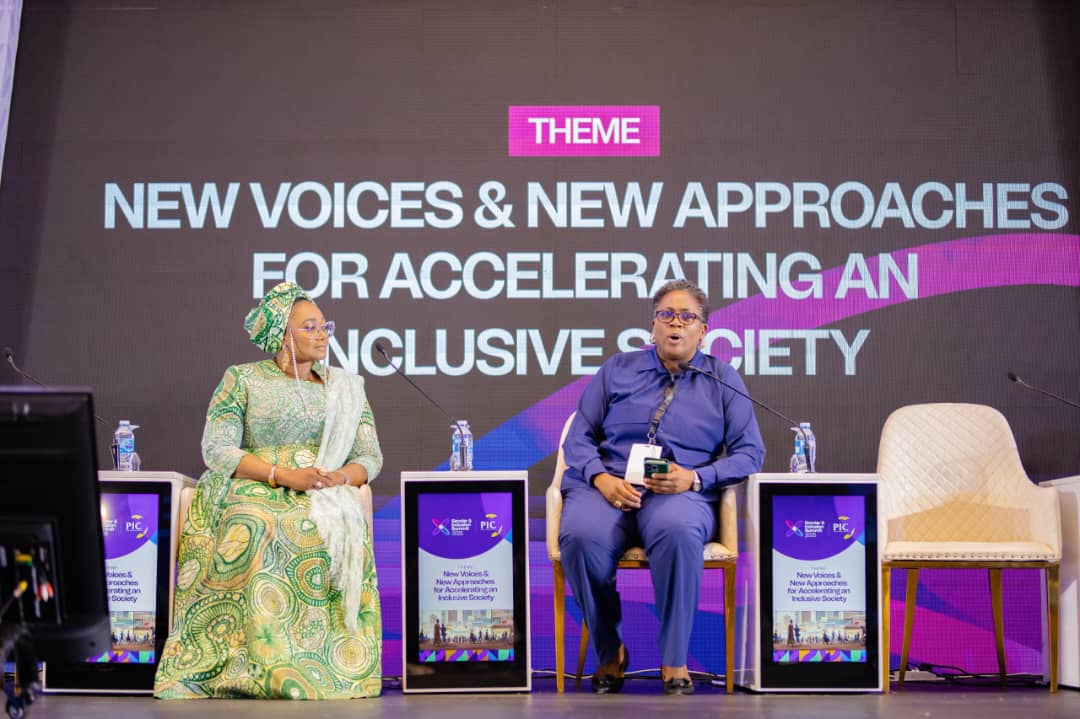
Speaking during a fireside chat at the Gender and Inclusion Summit 2025 (GS-25) in Abuja, the Minister said President Bola Ahmed Tinubu’s administration is committed to ensuring that women drive Nigeria’s growth story.
“The vision is simple. Mr. President has a goal of putting women at the centre of national development. He has asked us to strengthen the economic power of the Nigerian woman,” she said.
Unlocking a Trillion-Dollar Economy
Sulaiman-Ibrahim urged stakeholders to imagine the transformative impact of women earning three times more than they currently do, arguing that such growth would unlock the pathway to a trillion-dollar economy.
“Just close your eyes and imagine Nigeria where women are earning three times more than they are earning now. It takes us very closely to our goal of a one trillion dollar economy. Nigerian women can do more.”
She stressed that “when women have money in their hands, most of our problems as a country will begin to disappear.”
Tackling Social Challenges Through Empowerment
The Minister directly linked women’s economic empowerment to addressing Nigeria’s pressing social issues, including out-of-school children, nutrition, and gender-based violence.
“From out-of-school children — there is no woman who has money that her kids will not go to school. More than 50% of our children in Nigeria are starving. That’s an emergency. When women have money, will we have nutrition problems?” she asked.
On gender-based violence, she made a striking point: “Will a man beat a woman that has money? Where will he see her to beat her?”

Financing Women’s Growth
Noting the chronic under-investment in the women’s sector, Sulaiman-Ibrahim announced plans for a new **Women’s Fund** that will serve both Nigeria and African women broadly.
“The women’s space in Nigeria is not well invested in. It’s been under-invested. So I think first things first is we need a women’s fund… The government can’t do it alone. We are putting a structure for a fund that will be highly accountable.”
She emphasized that sustainable financing would require partnerships across government, private sector, and civil society.
Building Unity of Purpose
The Minister further urged all stakeholders to unite behind the Ministry of Women Affairs, describing it as the country’s legal instrument for gender inclusion.
“We must work as a bloc. Because when we don’t do that, then we’re weakening the federal government’s instrument… It’s very important that we work as a bloc, private sector, public sector, for us to speak in one voice and to work together.”
A Legacy of Empowerment
Looking ahead, Sulaiman-Ibrahim said her personal and institutional legacy would be measured by how well women are empowered economically.
“I think everything starts and ends with economically empowering a woman. And that’s what I would like for my legacy to be. That’s what I would like for Mr. President’s legacy to be.”
She cited menstrual hygiene policies, family strengthening programmes, and expanded access to markets and finance as part of the enabling environment government is working to create.
“It’s Women O’Clock”
Closing with a rallying cry that echoed through the Summit halls, participants adopted the phrase “It’s Women O’Clock” as both a slogan and a movement, underscoring the urgency of action.
The two-day Gender and Inclusion Summit convened by the Policy Innovation Centre featured dialogues, policy sessions, and the outcomes will be compliled in “the Purple Book”, a roadmap for accountability and inclusive growth.