

By ThankGod Inalegwu
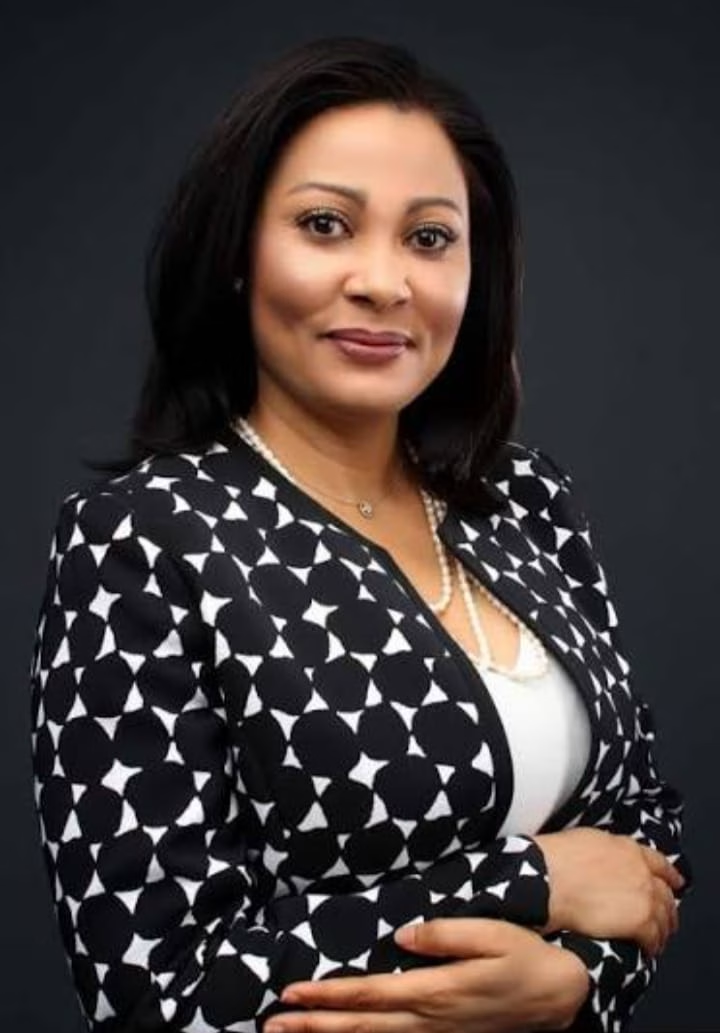
President Bola Ahmed Tinubu has reportedly redeployed the Minister of State for Finance, Doris Uzoka-Anite, following mounting concerns over the non-disbursement of about ₦1.15 trillion in approved capital funds and growing criticisms of her handling of key financial responsibilities.
Sources within government circles said the decision was taken after weeks of scrutiny over the stalled implementation of capital projects across the country despite substantial allocations in recent budgets.
The development comes after a tense session at the House of Representatives Committee on Budget defence hearing where lawmakers raised alarm over the huge sum of approved funds that had yet to be released for projects.
During the hearing, Hon. Alex Mascot Ikwechegh, who represents Aba North/Aba South Federal Constituency, confronted officials of the Federal Ministry of Finance over the fate of the ₦1.15 trillion, which represents about 30 percent of the 2025 capital budget.
Ikwechegh presented documents showing several funding approvals and borrowing arrangements, including $1.2 billion for digital infrastructure, $500 million for economic stimulus, $500 million for MSME support approved in December 2025, and $500 million from the African Development Bank for economic governance and energy transition.
He also referenced a recent executive loan request totalling $21 million, ¥15 billion and €4 billion.
Despite these financial inflows and approvals, the lawmaker said capital projects across Nigeria remained at zero percent disbursement, raising questions about the management of public funds.
“With all these funds put together, I want you to enlighten us on why the 2024 budget is yet to be fully implemented and why the 2025 budget has only been funded about 34 percent, most of which is recurrent expenditure,” Ikwechegh said during the hearing.
The lawmaker further asked why capital expenditure had effectively stalled, stating that Nigerians were yet to see the impact of the funds on development projects nationwide.
When the committee pressed for answers, the Minister of Finance and Coordinating Minister of the Economy, Wale Edun, reportedly shifted responsibility for the disbursement process to the Minister of State for Finance.

Following the exchange, the committee summoned Uzoka-Anite to appear before lawmakers to clarify the status of the funds.
At the subsequent session, the minister confirmed that the ₦1.15 trillion had indeed been approved but explained that the funds had not been disbursed because certain “pre-disbursement conditions” had not been met by some ministries.
However, when pressed by Ikwechegh to identify ministries that had fulfilled all requirements but were still awaiting funding, she was unable to provide a specific example.
The response triggered further concerns among lawmakers, who suggested that the situation could indicate either poor financial coordination or possible irregularities in the approval and release of funds.
Speaking after the hearing, Ikwechegh warned that if the discrepancies were confirmed, they could amount to a serious breach of financial regulations.
“If this infraction is identified, it means there has been misappropriation of funds, which is a crime,” the lawmaker stated.
Meanwhile, Mr. Taiwo Oyedele, a respected tax reform expert and policy analyst who previously chaired the Presidential Committee on Tax Reforms, has been named as Uzoka-Anite’s replacement.
Government insiders say his appointment is expected to strengthen fiscal reforms and improve transparency in the management and disbursement of public funds.
The controversy has also sparked reactions from contractors across the country who claim they executed government projects with borrowed funds but have yet to receive payments, leading to mounting bank interest and protests over delayed settlements.
Observers say the situation has further highlighted ongoing challenges in Nigeria’s budget implementation process and the urgent need for improved fiscal accountability within the federal government