

By Rt. Hon. Linus Abaa Okorie, FCA
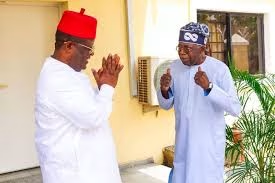
Recent remarks attributed to the Minister of Works, Senator Engineer David Nweze Umahi, CON, suggesting that the Igbo are no longer marginalised in Nigeria and that agitation for justice has become unnecessary under the current administration, deserve a calm, honest and fact-based response. This intervention is not written to criticise him, diminish his efforts or question his competence. It is offered in good faith—to help set the record straight—so that Nigerians, and especially Ndigbo, can assess our present reality clearly, without sentiment, fear or political pressure.
The Igbo quest for fairness did not begin with roads, and it cannot end with them. Roads—no matter how well built or how long they are projected to last—are not favours. They are funded by national resources to which the Igbo contribute significantly. They are part of the basic obligations of government, not proof of justice, equity or full integration. To equate the rehabilitation or construction of long-abandoned roads with genuine inclusion in the Nigerian project is to dangerously lower the standard of citizenship and to misunderstand the deeper grievances that have lingered for decades.
If road construction alone were the true test of justice, then the President’s South-West—with the Lagos-Ibadan Expressway, Lagos-Abeokuta Road, Lekki Deep Sea Port access roads, Lagos-Badagry Expressway, extensive federal flyovers, rail projects and the multi-trillion-naira Coastal Highway—would qualify as not just integrated, but overwhelmingly favoured. Yet no serious observer argues that roads alone resolve questions of equity. Why, then, should the Igbo be asked to accept that logic?
True integration is reflected in who occupies the commanding heights of the state and how power, opportunity and justice are distributed. On this score, the publicly available facts remain uncomfortable. The South-East continues to be largely absent from the leadership of Nigeria’s core security, economic and regulatory institutions. The armed forces, police, intelligence services, customs, immigration, revenue agencies, oil and gas institutions, ports and aviation authorities remain overwhelmingly dominated by other zones.
Yes, an Igbo son, Air Vice Marshal Sunday Kelvin Aneke, currently serves as Chief of Air Staff, and this is welcome. But one appointment, however prestigious, cannot mask a broader and persistent pattern of exclusion. Token gestures do not cure structural imbalance, just as the Ministry of Works—important as it is—cannot compensate for systematic absence from the centres where national power and resources are truly controlled.
Ministerial appointments tell a similar story. The South-East remains the only geopolitical zone with five states instead of six—a historical injustice that continues to translate into fewer representatives at the federal level. Even among the limited number of ministers appointed from the five Igbo states, only Engr. Umahi presides over a core ministry. None of the others controls a strategic portfolio that shapes security policy, fiscal direction, energy control or national economic planning. Presence without power is symbolism, not inclusion.

Budgetary patterns further expose the gap between official rhetoric and lived reality. Year after year, projects in the South-East are under-captured, under-funded and poorly released. Announcements are made, figures are quoted and ceremonies are held, yet actual disbursements lag behind, projects stall, costs escalate and timelines shift endlessly. When compared with other regions—particularly the South-West—where budget capture is stronger, releases are quicker and delivery more consistent, it becomes clear that what is often presented as generosity is, in truth, delayed restitution for years of neglect.
Policy design and implementation deepen this imbalance. Major transport corridors, ports, rail lines, energy hubs and industrial zones are consistently structured to reinforce existing regional advantages. Despite its population density, entrepreneurial drive and strategic location, the South-East remains boxed in by weak federal presence and limited policy imagination. A nation cannot credibly claim integration while maintaining systems that routinely sideline one of its most productive regions.
No honest conversation about marginalisation can avoid the question of justice and the rule of law. Across Nigeria, armed agitations in other zones have been met with dialogue, amnesty and political accommodation. Yet in the South-East, the case of #NnamdiKanu—whose agitation was largely unarmed—has evolved into a defining symbol of unequal treatment. Following a prolonged and controversial legal process, he has now been convicted and sentenced to life imprisonment and therefore faces the prospect of spending the rest of his life in custody. Regardless of differing opinions about his methods or message, the handling of his case continues to raise profound questions about proportionality, consistency and equality before the law. This is not an endorsement of separatism. It is a call for equal justice under the law. A country that treats comparable grievances differently cannot reasonably expect trust or loyalty to endure.
Beyond politics and security, the everyday economic experience of the Igbo tells its own story. Igbo traders and businesses continue to face disproportionate demolitions, weak compensation regimes and regulatory hostility in major commercial centres. Markets and estates are destroyed, livelihoods disrupted and communities impoverished, often without the empathy or remedial support extended elsewhere. Economic equity is not an abstract concept; it is felt daily in markets, transport corridors, ports and industrial zones. On this front too, the imbalance remains glaring.
It must therefore be said, with respect and clarity, that personal access to power must never be mistaken for collective progress. Engr. Umahi’s current position as a powerful minister is a personal achievement and a testament to his abilities. But the fortunes of one individual—no matter how prominent—cannot substitute for the wellbeing of an entire people. History offers many examples of individuals who thrived within unequal systems while their communities remained excluded. Silence, or excessive optimism, does not heal injustice; it merely delays accountability.
This is why Ndigbo must remain alert. Not hostile. Not venomous. Not separatist. But alert. We must resist narratives that ask us to trade truth for temporary comfort or to confuse symbolic gestures with genuine inclusion. Our demand has never been for chaos or disintegration. It has always been for justice, fairness and equity within the law. These are not Igbo demands alone; they are Nigerian ideals.
To those who hold power today, this message is offered in good faith. National unity is not built on selective appointments or symbolic projects. It is built when every group feels respected, protected and treated as an equal stakeholder in the federation. Justice is not a favour. Equity is not a concession. Inclusion is not tokenism.
Engr. Umahi’s optimism reflects his vantage point. The broader Igbo experience—measured by appointments, budgets, policies, justice and economic opportunity—tells a more sobering story. Acknowledging this truth is not disloyalty to Nigeria; it is patriotism. Only by confronting uncomfortable realities can we build a nation that truly belongs to all its peoples.
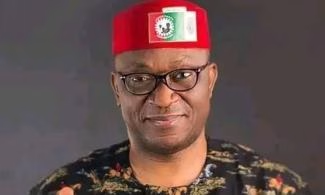
Rt. Hon. Linus Abaa Okorie, FCA is former Member, House of Representatives (2011-2019) and Labour Party Senate Candidate for Ebonyi South, 2023.