

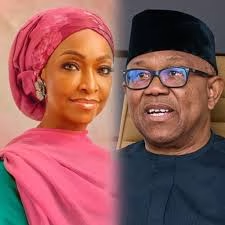
The APC has long thrived on propaganda, innuendo, and division. Yet even within that atmosphere, moments of unintended truth occasionally slip through.
One such moment came during Hannatu Musa Musawa’s interview with Seun Okinbaloye, where she spoke about Peter Obi’s prospects in the North. For many of us, her words were a confirmation of what has always been clear: Nigerian presidential politics is built on alliances that are credible, strategic, and genuinely crossregional.
No candidate wins the presidency through regional strength alone. No one succeeds by relying solely on personal popularity or isolated support bases. This is why Musawa’s words struck a chord with political reality that seasoned observers have understood for decades.
Her comparison between Peter Obi’s current position and Muhammadu Buhari’s earlier struggles is particularly instructive. Buhari, despite commanding fierce loyalty in the North, failed in 2003, 2007, and 2011. His support was deep but geographically limited. It was only when he forged a partnership with Bola Ahmed Tinubu, who delivered a consolidated SouthWest bloc, that the political equation shifted. That alliance, carefully negotiated and mutually beneficial, produced the 2015 victory.
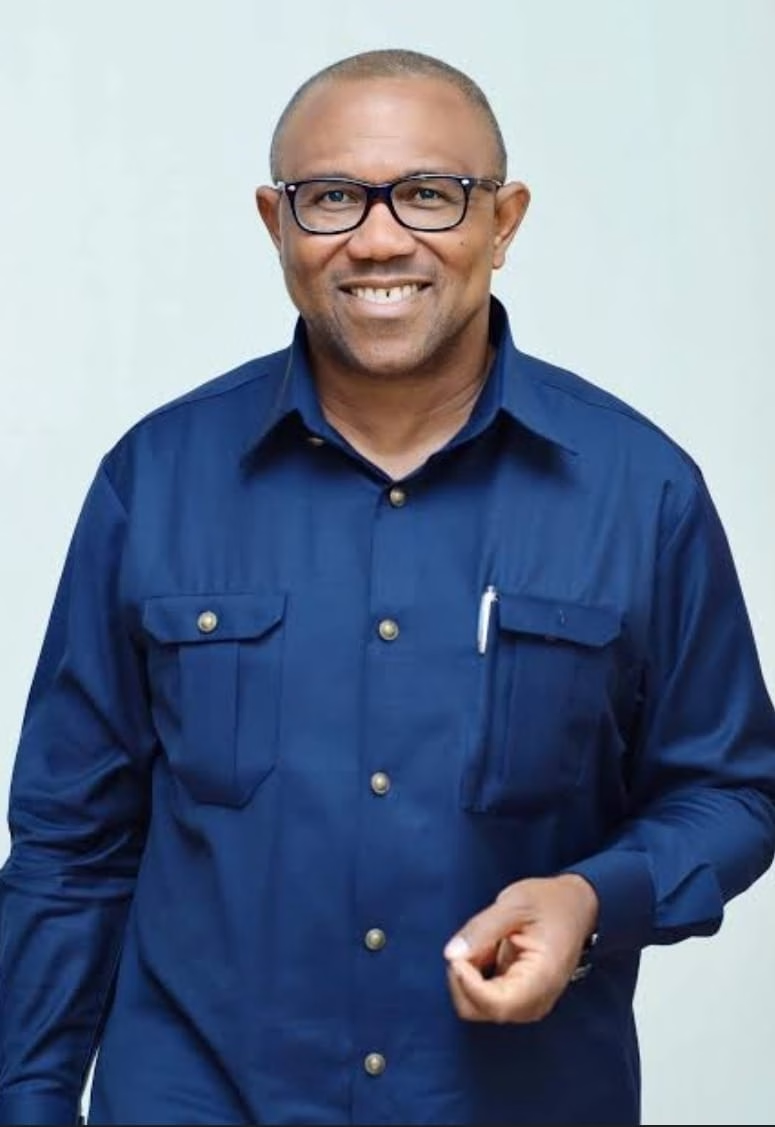
But that is only half the story. The other half is the distinction Musawa conveniently left out. Unlike Tinubu, who needed a southern bridge to consolidate Buhari’s already massive 12millionvote northern base, Peter Obi begins from a fundamentally different position. Obi has already demonstrated a rare national appeal that cuts across age, religion, ethnicity, and geography. His 2023 performance showed dominance in the South, strong inroads in the Middle Belt, and significant urban traction in the North. His challenge is not acceptance but consolidation.
What Obi requires is not a bridge to create support, but a bridge to anchor and protect his win. He needs a credible northern partnership capable of transforming goodwill into structured political machinery. More importantly, he needs a strong elite consensus that is capable of safeguarding electoral outcomes in a country where INEC, security agencies, and even the judiciary often operate under the overwhelming influence of the ruling party. In such a system, winning votes is only half the struggle; defending those votes is the other half.
And as Obi moves into deeper northern engagement, one thing must be made clear: Obidients must stop dictating to him. This is not the time for emotional rigidity or internal policing of his choices. Whatever strategic decisions he makes , who he partners with, who he aligns with, even if he chooses to deputise someone unexpected, must be supported. Times like these demand clarity, discipline, and yes, desperate measures. Political victory is never achieved by a divided base secondguessing its own leader.

This is why Musawa’s remarks should not be dismissed as mere political rhetoric. In truth, they were a strategic slip (a political faux pas) that inadvertently reinforced the focus of the Obidient movement. If Tinubu could build a bridge that turned Buhari’s regional dominance into national victory, then Obi can certainly build one that converts his broad national appeal into a secure pathway to power.
The North is not unreachable. It simply requires engagement, respect, and credible alliances with leaders who command trust. That engagement must begin with progressive northern elites willing to undo decades of negative political conditioning, the type of conditioning planted by successive power blocs across all regions since the First Republic and deepened by the scars of the civil war.
For this unexpected clarity, Musawa deserves thanks. She has said openly what many already knew: Peter Obi’s path to Aso Rock is not blocked; it is a work in progress. It is simply incomplete. And completing it requires the same political arithmetic that has shaped every successful presidential bid since 1999.
Obi does not need to replicate Buhari’s journey; he needs to refine it. With the right northern bridge, a disciplined support base, and a firm elite consensus, his national appeal can finally translate into a victory that is not only won, but defended.
Dr Ezeh Emmanuel Ezeh, a member of the Obidient National Advisory Council, is an Oxfordtrained Strategist and LSEeducated Economic and Fiscal Policy Analyst. He writes frequently on governance, political reforms, and civic awakening. He was the 2023 House of Representatives candidate for Abakaliki/Izzi Federal Constituency in Ebonyi State.
Blog: @ ezehezeh.org