

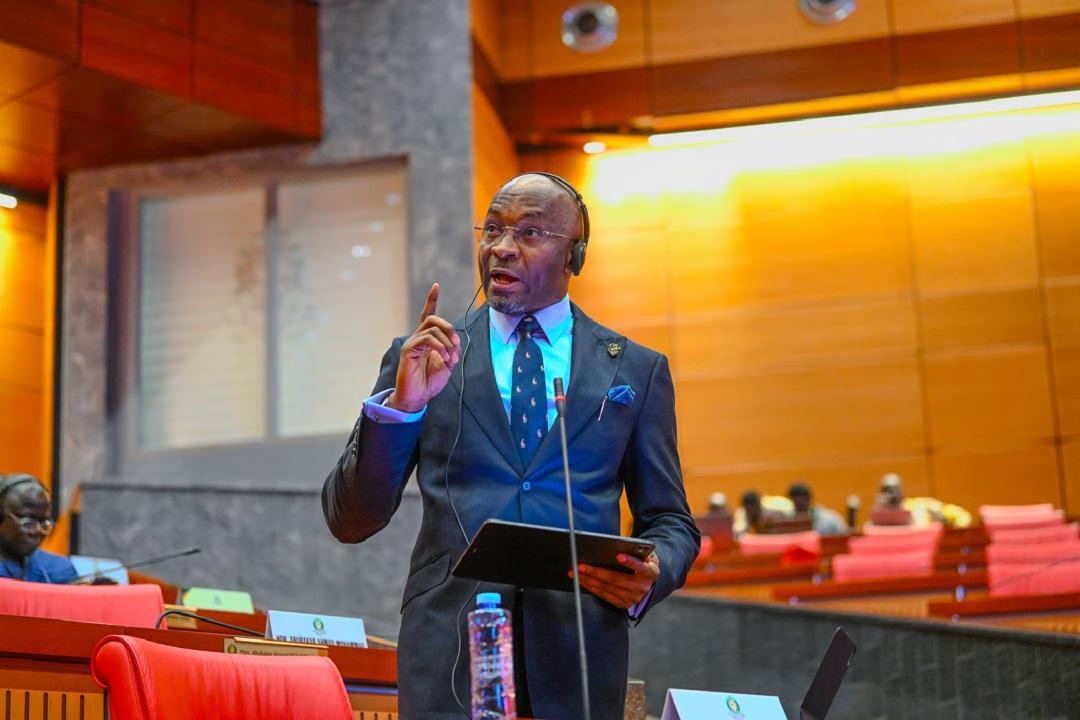
The Deputy Speaker of Nigeria’s House of Representatives, Rt. Hon. Benjamin Kalu PhD, has called for an urgent shift from what he described as “paper integration” to “functional integration” in the implementation of the African Continental Free Trade Area within the Economic Community of West African States sub-region.
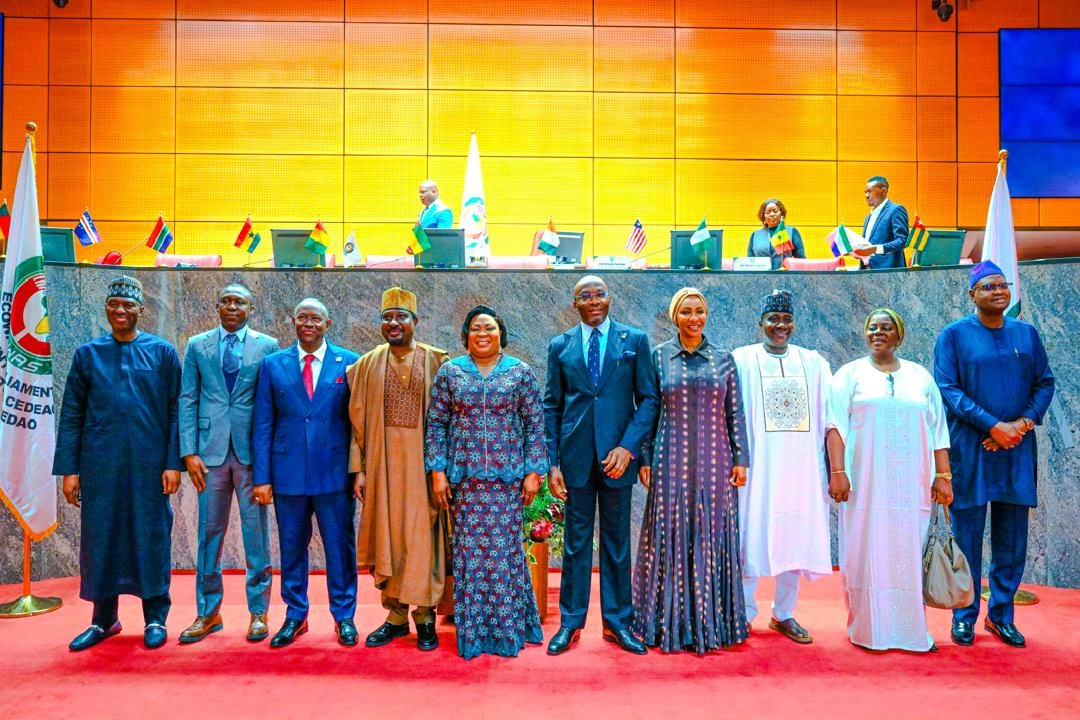
Kalu made the call during his contribution at the Parliamentary Seminar titled “Deepening Regional Integration Through the African Continental Free Trade Area (AfCFTA): Opportunities and Challenges for Expanding Intra-Community Trade Within ECOWAS.” held in Abuja on Monday.
Addressing his colleagues, the Deputy Speaker noted that while intra-African trade rose to $220.3 billion (16%) in 2025, intra-ECOWAS trade remains stagnant at 11.5%, despite the region’s vast $3.4 trillion market potential.
He lamented that logistical and administrative bottlenecks continue to undermine progress.
Kalu emphasized that bridging the gap between aspiration and reality requires deliberate action, particularly in infrastructure and enforcement.
Describing the Abidjan–Lagos corridor as the backbone of the regional economy, he said it remains an unfinished promise.

However, he stressed that beyond physical infrastructure, administrative inefficiencies pose even greater challenges.
Kalu said, “In today’s geopolitical climate, AfCFTA is no longer just a trade agreement; it has become the strategic engine that must power Africa’s industrial resilience and survival. In a world of fragmenting global supply chains, Africa must trade withitself to thrive. While intra-African trade successfully climbed to $220.3 billion (16%) in 2025, our ECOWAS sub-region remained stuck at 11.5%. We are talking about a $3.4 trillion market potential, yet we still struggle to move a truck from Lagos to Abidjan.
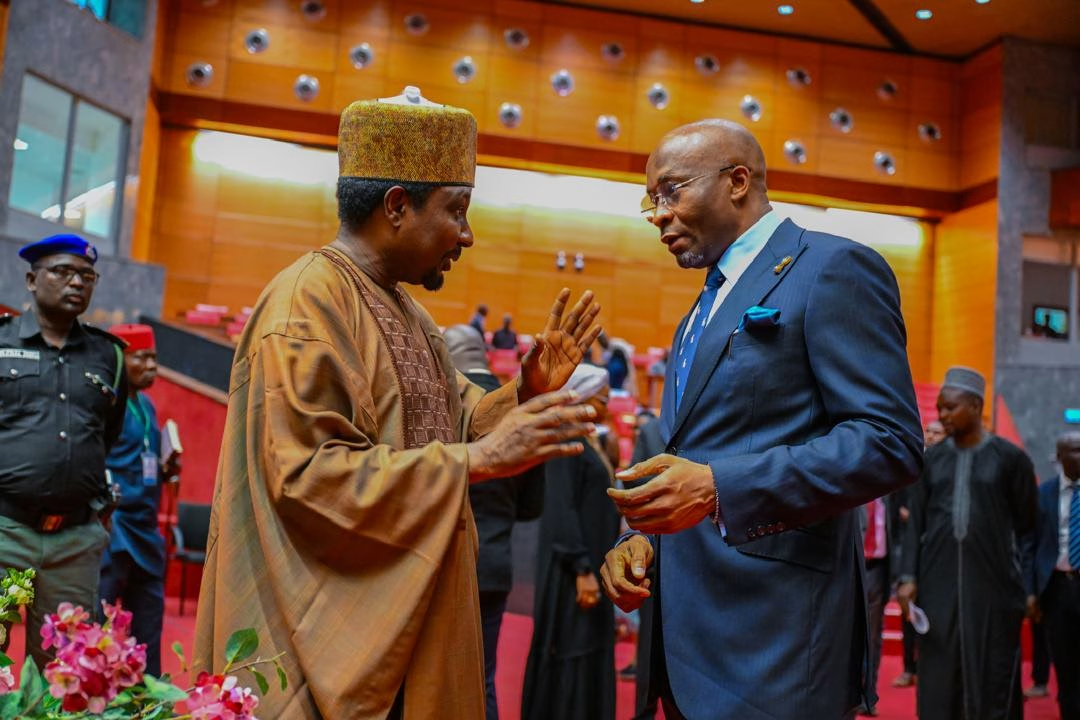
“To bridge the gap between our high-level aspirations and our regional reality, we must, as a matter ofurgency, transition from the diplomacy of ‘Paper Integration’ to the tangible impact of ‘Functional Integration.’ This requires a relentlessfocus on two critical levers:1. Infrastructures and the Implementation Gap1 The Abidjan-Lagos corridor, which is the backbone of our regional economy, remains an unfinished promise. But currently, it is not just the potholes that cost us; it is the administrative friction. We can build asix-lane highway, but if a truck spends 14 hours at a border due to redtape, that highway is just an expensive parking lot.We don’t just need a mechanism to report Non-Tariff Barriers (NTBs); we need a regional body with actual enforcement powers to penalise thebureaucratic delays that strangle our supply chains.”
On monetary integration, the Deputy Speaker urged ECOWAS leaders to adopt a pragmatic approach.
While acknowledging decades of discussions around a single regional currency, the Eco, Kalu described full macroeconomic convergence as increasingly unrealistic under present conditions.
Instead, he advocated prioritizing the Pan-African Payment and Settlement System (PAPSS), describing it as a functional and immediate solution to regional trade payment challenges.
“The Digital Switch: PAPSS over the “Eco”For decades, we have chased the dream of a single currency (the Eco).It is time for a reality check. Total macroeconomic convergence is a 20th-century mirage. Instead, we need to strategically direct our energytoward the Pan-African Payment and Settlement System (PAPSS). The Reality is that PAPSS provides some of the key benefits of a single currency; including instant settlement in local currencies, without the loss of national sovereignty.
“It also eliminates the “Dollar-dependency” that costs Africa $5 billion annually in transaction fees. Why wait in perpetuity for a shared banknote when we can solve the payment problem today with a digital switch?Let us stop debating whose face goes on a currency that does not existand start connecting central banks to a system that already works. By prioritising the Guided Trade Initiative (GTI), we make the AfCFTA a reality for the manufacturer in Aba, the agro-processor in Cote d’Ivoire,and the small-scale trader in The Gambia,” The Deputy Speaker said