

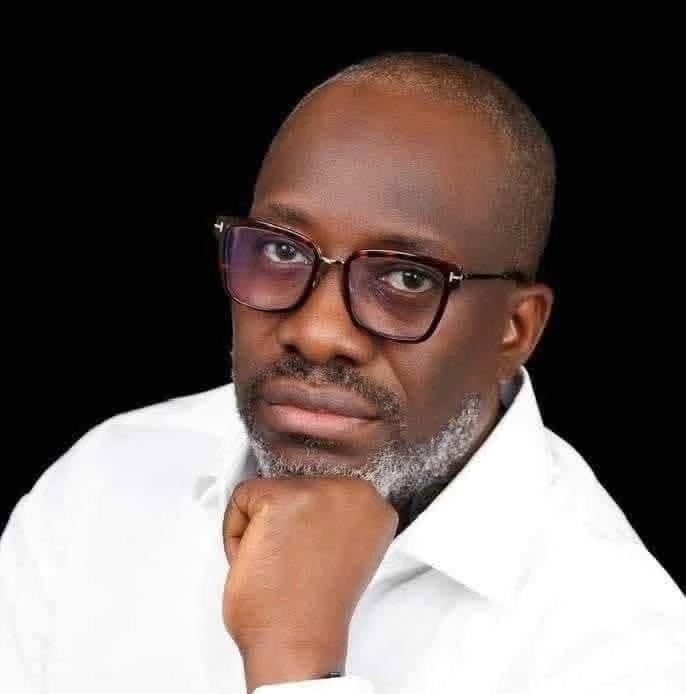
By Otunba Segun Showunmi
Nigeria is approaching a dangerous threshold.
Today, there is no major political party without serious legal troubles leadership disputes, candidate legitimacy battles, and court cases that now define political life. This is not normal democratic competition. It is a sign of institutional distress.
Political parties are meant to stabilise democracy. When they are all unstable, democracy itself becomes fragile. Elections lose finality, mandates lose clarity, and governance becomes permanently distracted. A nation cannot move forward while its political system is locked in continuous litigation.
This moment should concern everyone not just politicians.
When citizens can no longer trust political parties, faith in elections erodes. When elections lose credibility, people disengage. And when disengagement spreads, democracy weakens quietly, not suddenly until it can no longer defend itself.
What makes this moment especially troubling is that ideological clarity has become rare. The Labour Party’s appeal today rests largely on the fact that its ideology is clear and universally understood. That this stands out at all is an indictment of the wider political system.
This did not happen overnight. It is the result of years of neglect:
• parties reduced to vehicles for power,
• internal democracy hollowed out,
• money and litigation replacing ideas and consensus,
• institutions enforcing rules inconsistently.
The danger ahead is subtle but real. When democratic processes appear unreliable, societies become vulnerable to apathy, extremism, or authoritarian temptation. History shows that democracies do not always collapse with noise many fade through indifference and fatigue.

This is therefore a moment for restraint, reflection, and reform.
Nigeria urgently needs:
• strict and impartial enforcement of party and electoral laws,
• internal democracy within political parties,
• clear ideological commitments, and
• institutions strong enough to uphold rules without fear.
This is not a partisan appeal. It is a civic one.
If this trajectory continues unchecked, Nigeria risks becoming a democracy in appearance but not in substance where elections occur, but legitimacy is always questioned.
This is a calm alarm, not a cry of panic.
But it is an alarm nonetheless.
And it deserves to be taken seriously now.
Otunba Segun Showunmi
Dan Maliki
The Alternative.