
Our Economic Reforms Have Taken Nigeria Out of Emergency Ward- President Tinubu


President Bola Ahmed Tinubu, has said following the reforms initiated by his administration, economic indicators have shown that Nigeria is out of the ’emergency ward.’
The President said instead of taking the “comfortable road of cosmetic remedies,” his administration chose the “hard road of surgery to save the patient.”
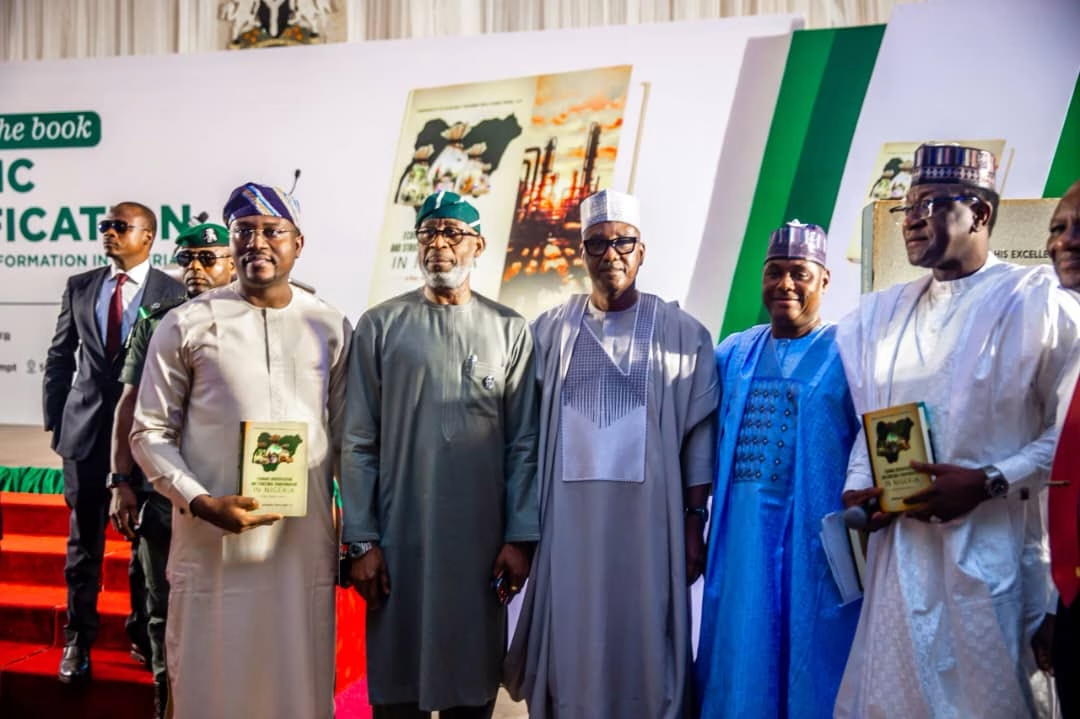
President Tinubu, represented by Speaker of the House of Representatives Rt. Hon. Abbas Tajudeen, said this at the public presentation of the book, ‘Economic Diversification and Structural Transformation in Nigeria: Past, Present and Future.’
Authored by the lawmaker representing Kiru/Bebeji Federal Constituency, Kano State, Hon. Dr. Abdulmumin Jibrin Kofa, President Tinubu wrote the foreword of the book.
At the unveiling ceremony, the President said, “For too long, Nigeria’s story was a song sung in a single note. We were a nation of boundless promise tied to a single product: our budget, our currency, and the livelihoods of millions rising and falling with the tides of a distant oil market. We floated on the fragile illusion of oil wealth while the foundations beneath us cracked.
“When I took the oath of office, I did not inherit a calm sea; I inherited a gathering storm: a collapsing naira, debt service that swallowed nearly all our revenue, depleted reserves, a fuel subsidy that bled our treasury dry, and factories falling silent as industries and jobs fled across our borders.”
He noted, “Two roads lay before us. One was the comfortable road of cosmetic remedies that had led us to the edge of the cliff. The other was the hard road of surgery to save the patient. We chose reform over ruin. We removed the fuel subsidy. We unified the exchange rate.
“These were not easy decisions, and I know the weight they placed on every household. But they were necessary, and today the pain is yielding its promise. The emergency ward is behind us.”
President Tinubu said non-oil activities now account for about 96 per cent of our Gross Domestic Products (GDP), while non-oil exports have crossed $6 billion, “the highest in our history.”
He also said the country’s external reserves have risen to about $55 billion, more than 14 months of import cover. He added that non-oil revenue has grown from ₦13.63 trillion in 2023 to ₦16.4 trillion in the first half of this year alone.
“Our task has moved from stabilisation to shared prosperity, and our compass points firmly to a trillion-dollar economy by 2030, charted in the Medium-Term National Development Plan 2026–2030,” he stressed.
The President stated that the government alone cannot build a trillion-dollar economy, noting that wealth is created by enterprises that invest, innovate, manufacture, and export.
“Our duty is to clear the path before them. That is why our 2025 budget introduced a first-of-its-kind De-risking Framework to draw in private capital, which we expect to provide 86 per cent of the investment our 2030 goal demands.
“That is why we are harmonising our taxes, ending the menace of multiple taxation. We cannot tax our way into prosperity; we must produce our way there,” he said.
While stating that a nation is not lifted by statistics alone, the President pointed out that numbers must become “bread on the table, light in the home and work for willing hands.”
Stressing that no nation has ever industrialised in darkness, President Tinubu said that is why the government fought for Mambilla, winning the $3.38 billion arbitration at the International Chamber of Commerce in Paris, and “freeing a project held hostage for more than nine years.”
He added, “That is why, on the strength of our market reforms, Geregu Power is moving to raise its capacity to 1,300 megawatts.”
In the Niger Delta, he said the Port Harcourt and Warri refineries are “stirring back to life,” stating that, “Energy is the heartbeat of diversification, and we are restoring its rhythm.”
The President went on to list a series of reforms and infrastructural projects across the sectors of the economy.
He said, “Distinguished guests, an age of prosperity is not a gift that falls from the sky; it is a house we must build together: government and enterprise, scholar and farmer, the young and the seasoned.
“The days of hardship are temporary; the foundations we are laying are permanent. Let us keep building until the world looks upon Nigeria and sees not promise deferred, but promise fulfilled.”
President Tinubu also thanked the Keynote Speaker, Governor Charles Soludo; Book Presenter, Alhaji Abdulsamad Isyaku Rabiu; and Book Reviewer, Dr. Reuben Abati, for lending their wisdom to the conversation.