

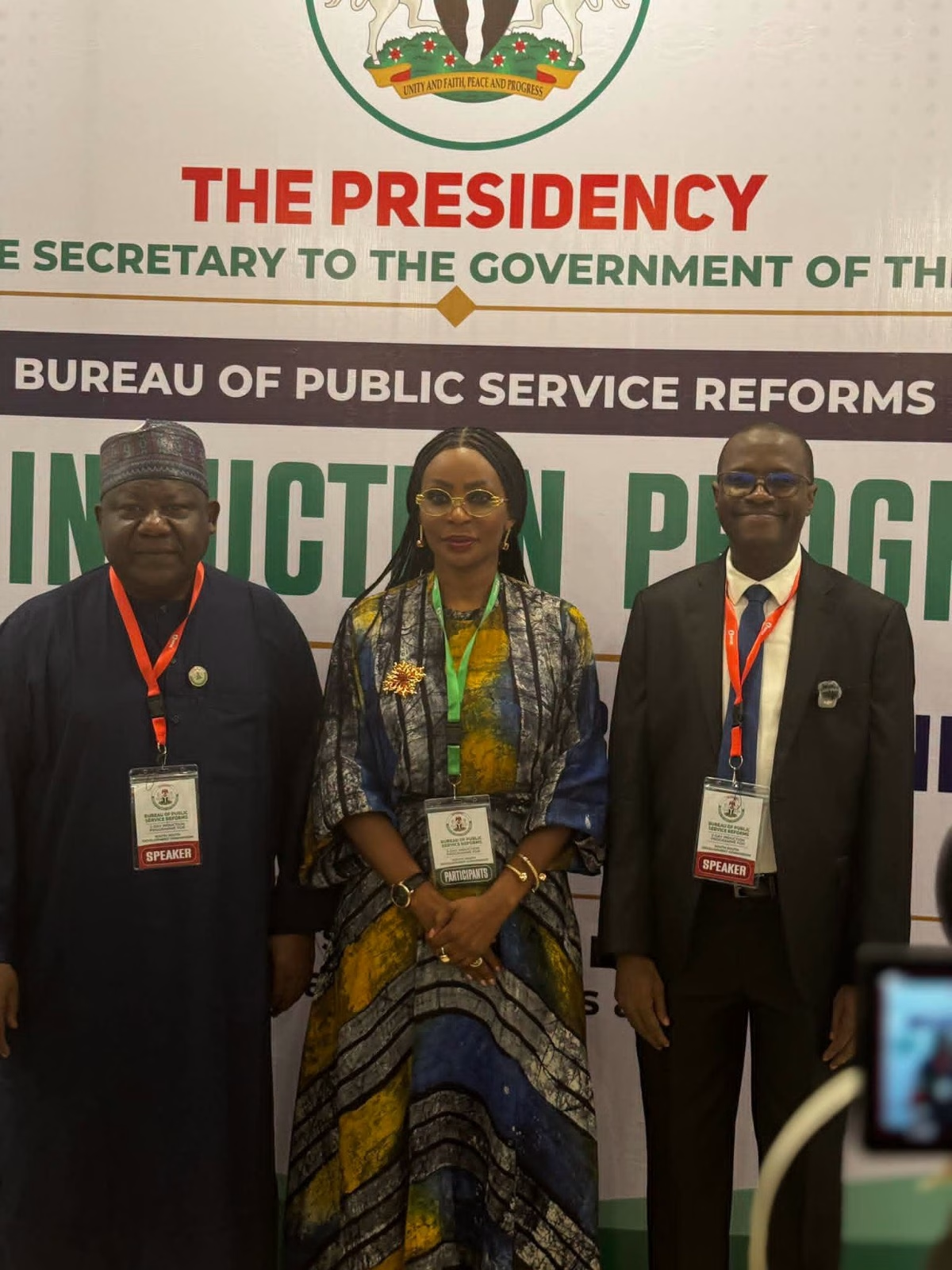

The Chairman of the Independent Corrupt Practices and Other Related Offences Commission (ICPC), Dr. Musa Adamu Aliyu, SAN, has charged the newly inaugurated South-South Development Commission (SSDC) to architect its operational framework upon the bedrock of integrity, transparency, and accountability; insisting these principles must be hardwired into its DNA from inception, rather than retrofitted as remedial measures.
Dr. Aliyu delivered this charge recently during the SSDC’s flagship Induction Programme in Abuja, a session he characterised as a singular, generational opportunity for the Commission’s Board and Management to erect preventive bulwarks before institutional inertia, weak oversight, or compromised protocols can take hold.
“Institutions do not become corrupt overnight,” Dr. Aliyu admonished the gathering. “Corruption germinates from minor concessions, ambiguous boundaries, and frail internal controls. The institutions that endure are those that deliberately cultivate integrity as their foundational ethos.” He underscored that unlike established agencies forced to overlay reforms upon entrenched malpractices, the SSDC possesses the rare advantage of commencing with a clean slate, enabling it to operationalise preventive mechanisms from its very genesis.
The ICPC helmsman anchored the induction on the Commission’s tripartite statutory mandate: prevention, enforcement, and public education as enshrined in the Corrupt Practices and Other Related Offences Act, 2000, with a pronounced accentuation on its prophylactic function. “No nation can prosecute its way out of corruption,” he asserted. “Enduring success resides in prevention.
The intensive induction programme traversed the legal and supervisory architecture governing the SSDC, the cardinal tenets of good governance —accountability, transparency, integrity, and stewardship; and the indispensable differentiation between governance and management functions, a demarcation the Chairman identified as a perennial flashpoint for institutional crises when conflated.
Participants were rigorously drilled on corruption risk hotspots endemic to Development Commissions, encompassing procurement malpractices, project selection biases, human resources malfeasance, financial mismanagement, community relations vulnerabilities, and the spectre of political interference. These theoretical constructs were grounded in stark realities, with the Chairman adducing illustrative case files prosecuted by the ICPC, including the recent forfeiture of acreage designated for a 962-unit legacy housing estate under the National Housing Fund Scheme, following the dissipation of approximately ₦14 billion without a single edifice erected. In another searing example, he detailed the ongoing recovery of nearly ₦942 million in salaries illicitly paid to 908 ghost workers, unearthed through the Integrated Personnel and Payroll Information System (IPPIS) investigation.
To insulate the SSDC from analogous pitfalls, Dr. Aliyu unveiled the ICPC’s comprehensive preventive arsenal: the Anti-Corruption and Transparency Unit (ACTU), Corruption Risk Assessment protocols, Systems Study and Review mechanisms, and robust ethics and integrity education programmes. He further presented ten immutable integrity commitments for the Commission’s leadership, complemented by a proposed five-pillar partnership framework encompassing integrity diagnostics, the establishment of a functional ACTU, sustained capacity development, rigorous compliance monitoring, and proactive public engagement.
In his concluding remarks, Dr. Aliyu posited that the ultimate barometer of the SSDC’s success would not be the magnitude of appropriated funds or the sheer tally of initiated projects, but the unimpeachable integrity with which public resources are stewarded, the luminous transparency of its decisions, and the enduring public confidence it engenders among the citizens of the South-South region, a legacy, he insisted, that must be forged from the very first day.