
Nigeria Reaffirms Leadership in West Africa as FG Pushes for Democratic Stability in ECOWAS

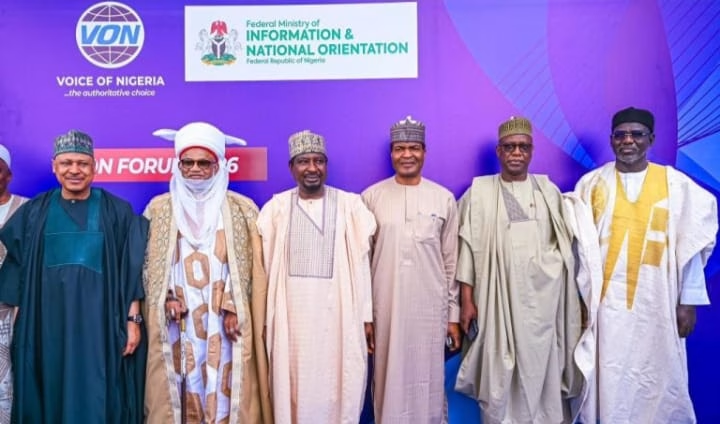

The Federal Government has reaffirmed Nigeria’s commitment to strengthening democratic governance and sustaining regional stability within the Economic Community of West African States, emphasizing the country’s enduring leadership role in West Africa.
This assurance was given at the 2026 Voice of Nigeria Forum held in Abuja, where policymakers, diplomats, and key stakeholders gathered to evaluate Nigeria’s contributions to regional integration under the theme: “51 Years of Nigeria’s Role in Deepening Democratic Stability in ECOWAS.”
Speaking at the event, the Minister of Information and National Orientation, Mohammed Idris, highlighted Nigeria’s consistent involvement in peacekeeping, mediation, and support for democratic transitions across the sub-region. He noted that the country’s foreign policy has remained firmly aligned with promoting peace, democratic governance, and regional cooperation.
According to Idris, Nigeria’s stability is intrinsically linked to developments across West Africa, stressing that the nation has remained at the forefront of efforts to foster unity and democratic values within ECOWAS member states.
He acknowledged ongoing political and security challenges in parts of the region but maintained that the administration of Bola Ahmed Tinubu is focused on strengthening institutions and encouraging dialogue among countries in the bloc. Idris also dismissed claims portraying Nigeria as unstable, pointing to improvements in security operations, easing inflation, rising investment inflows, and stronger external reserves as signs of recovery and growth.
In his remarks, Deputy President of the Senate, Barau Jibrin, said Nigeria has consistently invested resources in building and sustaining ECOWAS institutions since the bloc’s establishment in 1975. He described the regional body as a visionary initiative aimed at promoting collective security and economic cooperation, adding that democratic governance remains central to lasting stability in West Africa.
Jibrin further assured that the National Assembly would continue to back policies that enhance regional collaboration and integration.
Also speaking, the Director-General of the Voice of Nigeria, Jibrin Baba Ndace, said the forum was convened at a critical time when democratic institutions in parts of the region are under pressure. He noted that Nigeria has continued to serve as a stabilising force through peace missions, diplomatic engagement, and support for constitutional governance.
Ndace emphasized the importance of responsible journalism in shaping public discourse and countering misinformation, describing the media as a key pillar in sustaining democratic culture.
Participants at the forum agreed that preserving democratic stability in the ECOWAS region requires sustained collaboration among governments, civil society, the media, and international partners, particularly in advancing transparency, inclusion, and institutional reforms.
The renewed commitment comes amid shifting political dynamics in the Sahel, where Niger, Mali, and Burkina Faso have withdrawn from ECOWAS following prolonged disagreements with the bloc. The three nations, now aligned under the Alliance of Sahel States, formally exited in early 2025, raising concerns about regional unity, security cooperation, and the future of democratic governance in West Africa.
Observers say the development underscores the urgency for renewed commitment to ECOWAS principles and stronger cooperation among remaining member states to safeguard democratic gains and ensure long-term regional stability.