


By Amb. Anderson Osiebe.
Nigeria’s political landscape has once again been stirred by controversy following the criticism trailing the recent defection of Enyinnaya Abaribe to another political party outside the ruling All Progressives Congress (APC).
The backlash has raised fundamental questions about political tolerance, democratic fairness, and the apparent double standards in the reactions of the ruling party when lawmakers switch political allegiances.
For years, Nigeria’s political arena has witnessed a steady flow of opposition lawmakers defecting to the APC. In many cases, these defections were celebrated by the ruling party, welcomed with fanfare, and presented as proof of the APC’s growing political dominance.
Governors, senators, members of the House of Representatives, and even entire political structures have crossed over to the ruling party with little resistance.
However, the reaction to Senator Abaribe’s defection appears to tell a different story.
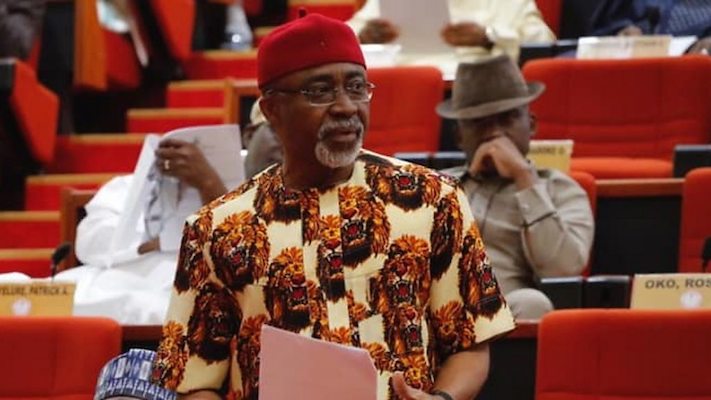
Senator Abaribe, a prominent figure known for his outspoken positions in the National Assembly, recently chose to align himself with another political platform (ADC) outside the APC. Rather than being treated as a routine democratic choice, his move has reportedly attracted criticism and discomfort from some voices within the ruling party.
Observers say this reaction highlights a troubling inconsistency in Nigeria’s political culture.
In a democratic system, freedom of association remains a core constitutional right. Political actors are expected to freely join or leave parties based on ideological alignment, political strategy, or the interests of their constituents.
Yet, critics argue that in Nigeria, defections are often celebrated only when they strengthen the ruling party but condemned when they weaken it.
Analysts note that the APC has historically benefited from high-profile defections since coming to power in 2015. Lawmakers from opposition parties have frequently moved to the ruling party without facing serious institutional or moral backlash from APC leaders.
These movements were often framed as evidence that the ruling party offered a better platform for governance and national development.
However, the criticism and attacks directed at Abaribe’s departure raises concerns about whether political actors are genuinely committed to democratic principles or merely supportive of defections when they serve their political advantage.
Political commentators say democracy must be consistent. If defections are considered legitimate when opposition lawmakers join the ruling party, the same principle should apply when a lawmaker decides to move in the opposite direction.
Nigeria’s constitution recognizes the right of politicians to associate freely with political parties. While provisions exist concerning defection, particularly in relation to legislative seats, these clauses are often interpreted differently depending on the political interests involved.
Many Nigerians therefore view the controversy around Abaribe’s move as more political than constitutional.
Supporters of the senator argue that his decision reflects the independence that elected representatives should exercise in a democratic system. They insist that lawmakers should not be intimidated or pressured into remaining in political parties that no longer align with their convictions or the interests of their constituents.
Beyond the individual case of Senator Abaribe, the issue highlights a deeper challenge within Nigeria’s political system: the culture of opportunistic politics.
Frequent defections, often without clear ideological differences between parties, have weakened the credibility of Nigeria’s multiparty democracy. Critics say political parties must move beyond mere platforms for electoral convenience and develop clear policy identities that guide political affiliation.
For many Nigerians, the controversy surrounding Abaribe’s defection ultimately exposes the hypocrisy that sometimes defines political reactions in the country.
As Nigeria approaches the next electoral cycle, the handling of political defections may serve as a test of the country’s democratic maturity. True democratic culture requires tolerance, consistency, and respect for political freedoms, regardless of who benefits from them.
If defections are welcomed when they strengthen the ruling party but condemned when they empower alternative platforms, observers warn that such inconsistency could undermine public trust in the political system.
For now, Senator Abaribe’s political move has once again placed the spotlight on the delicate balance between political strategy and democratic principle in Nigeria’s evolving democracy.
Amb. Anderson Osiebe, Executive Director, HallowMace Foundation, Public Policy Expert and an Administrator writes from Abuja – Nigeria.