
2026 Budget Defence: Reps Press Industry Ministry on Funding Gaps, Capital Vote

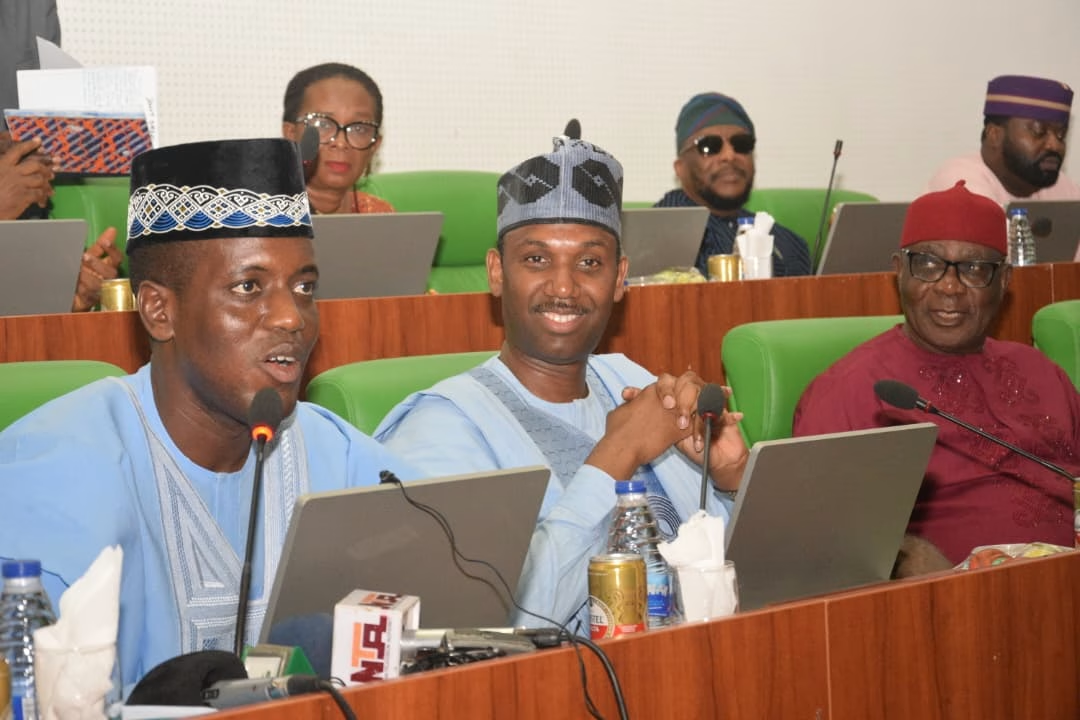

The House of Representatives Committee on Commerce on Wednesday warned that it would no longer endorse budgets that fail to deliver measurable economic impact, as the Federal Ministry of Industry, Trade and Investment sought an upward review of its ₦2.72bn proposed capital allocation for 2026.
Chairman of the Committee, Hon. Ahmed Munir Lere, set a firm tone at the 2026 budget defence, declaring that the era of routine approvals without tangible outcomes must end.
“We are not here for business as usual,” he said. “We are looking beyond fund exhaustion; we are looking for value-for-money and visible impact in the lives of Nigerians.”
His remarks came as the Minister of Industry, Trade and Investment, Dr Jumoke Oduwole, highlighted a sharp rise in capital inflows into the country even as she acknowledged persistent funding constraints.
Oduwole told lawmakers that Nigeria’s total capital importation rose to approximately $21bn in the first 10 months of 2025, up from about $12bn in 2024 and less than $4bn in 2023. She attributed the increase to targeted reforms under President Bola Tinubu’s Renewed Hope Agenda, including the curation of over $5bn in bankable projects, the creation of sector-specific deal rooms, and the hosting of Nigeria’s inaugural Domestic Investors’ Summit.
However, scrutiny intensified when she disclosed that in 2025, none of the ministry’s ₦3.89bn capital allocation had been released despite full utilisation of Personnel and Overhead votes and revenue performance exceeding target by about ₦100m, which was fully remitted to the Consolidated Revenue Fund.
The funding gap, lawmakers noted, raised concerns about implementation capacity heading into 2026.
In 2024, the ministry had a total appropriation of ₦14.39bn, with 93.2 per cent of the ₦8.36bn capital allocation released and fully expended. Revenue performance exceeded target by approximately ₦154m.
For 2026, Oduwole warned that the proposed ₦2.72bn capital vote would be insufficient to sustain industrial policy reforms, value chain development, expansion of Special Economic Zones, and trade facilitation initiatives.
She said Nigeria recorded a trade surplus in 2025, with total trade valued at about ₦113tn in the first three quarters, while exports rose by roughly 11 per cent year-on-year to $6.1bn, the highest recorded in both value and volume. Special Economic Zones, she added, generated over $500m in export revenue and created more than 20,000 direct jobs.
Despite the positive indicators, Lere insisted that headline figures must translate into structural economic transformation.
He said the committee’s oversight would be anchored on three pillars: domestic production, SME empowerment and trade expansion.
Describing 2025 as a year of “surviving the storm,” the chairman said the focus must now shift to “commanding the sea” by transforming Nigeria from a consumption-driven economy into a production powerhouse.
“With the African Continental Free Trade Area fully operational, Nigeria cannot afford to be a spectator,” he said, stressing the need for investment in standardisation, certification, digital trade infrastructure and export readiness.
The committee also examined agencies under the ministry, including the Tafawa Balewa Square Management Board (TBSMB), whose Managing Director, Mrs Lucia Shittu, highlighted funding pressures and infrastructure decay at the over 50-year-old Lagos complex.
Shittu disclosed that in 2025 the board was appropriated ₦1.74bn but only fully accessed personnel costs, with capital funding partially constrained. For 2026, it is proposing ₦1.79bn to rehabilitate aging infrastructure and reposition the national asset as a viable commercial and tourism hub.
She cited increased internally generated revenue through expanded event programming, including a major concert that attracted over 60,000 attendees but maintained that federal intervention was necessary to unlock the facility’s full commercial potential.
As scrutiny of the 2026 appropriation continues, lawmakers maintained that future approvals would depend not merely on expenditure patterns but on demonstrable outcomes in job creation, industrial growth and export expansion.