
NASS Joint Committee Raises Alarm Over Zero Capital Release to NDLEA, Demands Emergency Funding

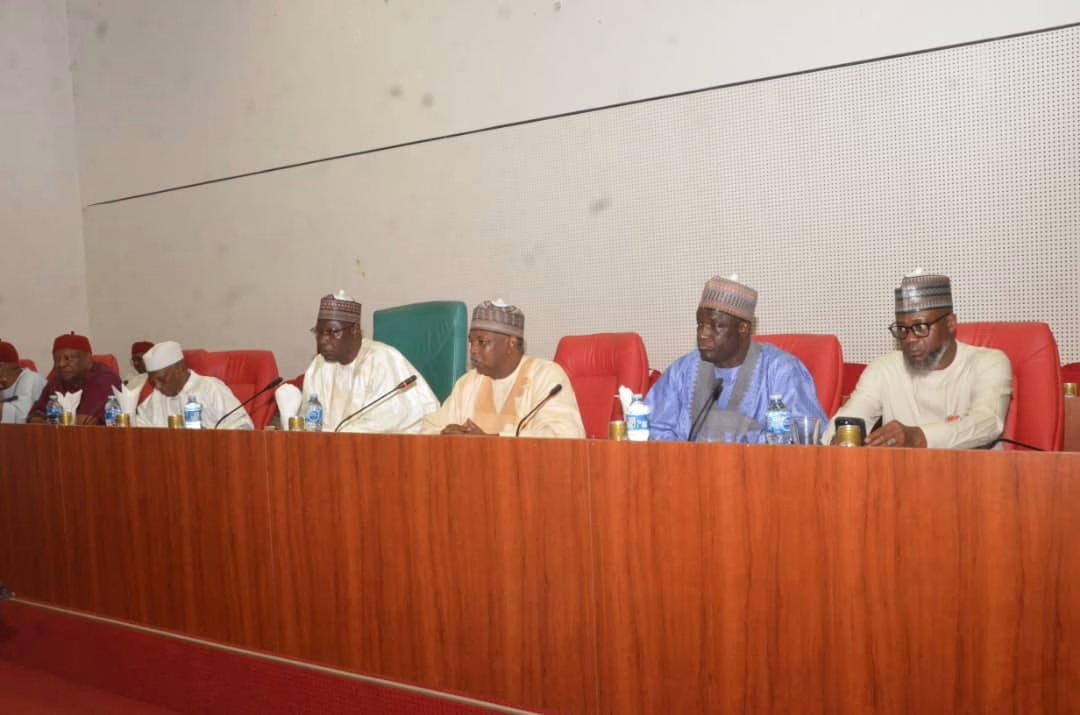

The National Assembly Joint Committee on Drugs and Narcotics on Thursday raised serious concerns over the non-release of capital funds to the National Drug Law Enforcement Agency (NDLEA) in 2025, calling for urgent financial intervention to strengthen the agency’s operations amid rising cases of drug abuse nationwide.
After scrutinising the agency’s 2026 budget proposal, the lawmakers identified significant shortfalls and decried what they described as persistently low appropriations to an institution central to Nigeria’s security architecture.
The committee, chaired by Senator Ibrahim Hassan Dankwambo and co-chaired by Hon. Abass Aboworin Adigun, reviewed the NDLEA’s 2025 budget performance following a presentation by the agency’s Secretary, Shadrach Haruna.
Members subsequently held a closed-door session to deliberate on critical operational and funding challenges. Addressing journalists afterwards, Hon. Adigun said discussions focused on repositioning the NDLEA as a priority national security institution.
He lamented that despite the devastating impact of drug abuse on Nigerian youths and its direct links to insecurity, the agency remains grossly underfunded.
“This agency ought to be among the top five institutions that receive serious national attention, yet it is not being prioritised,” Adigun said. “At least 50 per cent of the insecurity in our country is linked to drug abuse. If we fail to act decisively now, in the next 10 years the crisis could spiral out of control.”
He compared Nigeria’s funding for the NDLEA with that of the United States Drug Enforcement Administration (DEA), noting that while the U.S. commits billions of dollars annually to combat drug-related crimes, Nigeria’s allocation to its anti-narcotics agency remains inadequate.
According to him, the NDLEA operates with fewer than 14,000 personnel nationwide, with some state commands reportedly managing with as few as three operational vehicles. He further disclosed that the President declined assent to an amendment bill proposing that 2 per cent of the cost of collection from relevant revenue-generating agencies be allocated to fund NDLEA operations.
“We recommended just 2 per cent of cost of collection to support their operations, similar to what the Nigeria Customs Service enjoys, but it was withheld. We will continue to appeal for reconsideration,” he said.
Several lawmakers echoed the call for enhanced and sustainable funding, with some advocating that the NDLEA be placed on first-line charge to guarantee direct statutory funding from the Federation Account.
Senator Baba Njide Husseini cited a United Nations Office on Drugs and Crime (UNODC) report indicating that 14.4 per cent of Nigerians are affected by drug and substance abuse — nearly three times the global average.
“How can such a critical agency function effectively without capital releases?” he queried. “Drug abuse has filtered down into families. Women and children are increasingly involved. Most violent crimes today have links to substance abuse.”
Lawmakers also expressed concern over the state of NDLEA infrastructure nationwide, particularly projects inspected in Jos, and sought clarification on the agency’s collaboration with regulatory bodies such as the Pharmaceutical Council of Nigeria to curb the abuse of prescription drugs including tramadol and benzodiazepines.
In his response, NDLEA Secretary Shadrach Haruna acknowledged the funding constraints but highlighted operational achievements recorded within the review period. He disclosed that drugs valued at approximately N550 billion were seized, while 640 hectares of illicit cannabis farms were destroyed.
Haruna noted that although the 14.4 per cent prevalence rate was based on a 2018 UNODC survey, the agency believes the figure may have risen, but lacks the resources to conduct a fresh nationwide assessment.
He also revealed ongoing collaboration with international partners, including the U.S. DEA, to strengthen covert operations and financial intelligence investigations. According to him, the agency has established a dedicated department for drug demand reduction, intensifying sensitisation campaigns in schools, religious institutions and grassroots communities.
On the rejected 2 per cent cost-of-collection proposal, Haruna explained that the President’s decision was anchored on existing provisions of the Proceeds of Crime Act. Nonetheless, he appealed to lawmakers to explore alternative intervention mechanisms, similar to the Police Trust Fund, to ensure sustainable financing for the agency.
He stressed the strong nexus between drug trafficking and banditry, terrorism and other violent crimes, noting that substantial quantities of narcotics have been recovered from criminal hideouts during joint security operations.
The committee is expected to continue deliberations on possible funding frameworks in subsequent sessions, as lawmakers intensify pressure on the Federal Government to prioritise the fight against drug abuse, which they described as a ticking time bomb threatening Nigeria’s future.