


By Adama Linus
In the landscape of Nigerian politics, leadership is frequently judged by promises, eloquent speeches, and soaring rhetoric. Yet the genuine yardstick for any public servant remains the capacity to convert vision into concrete, life-changing results for ordinary citizens.
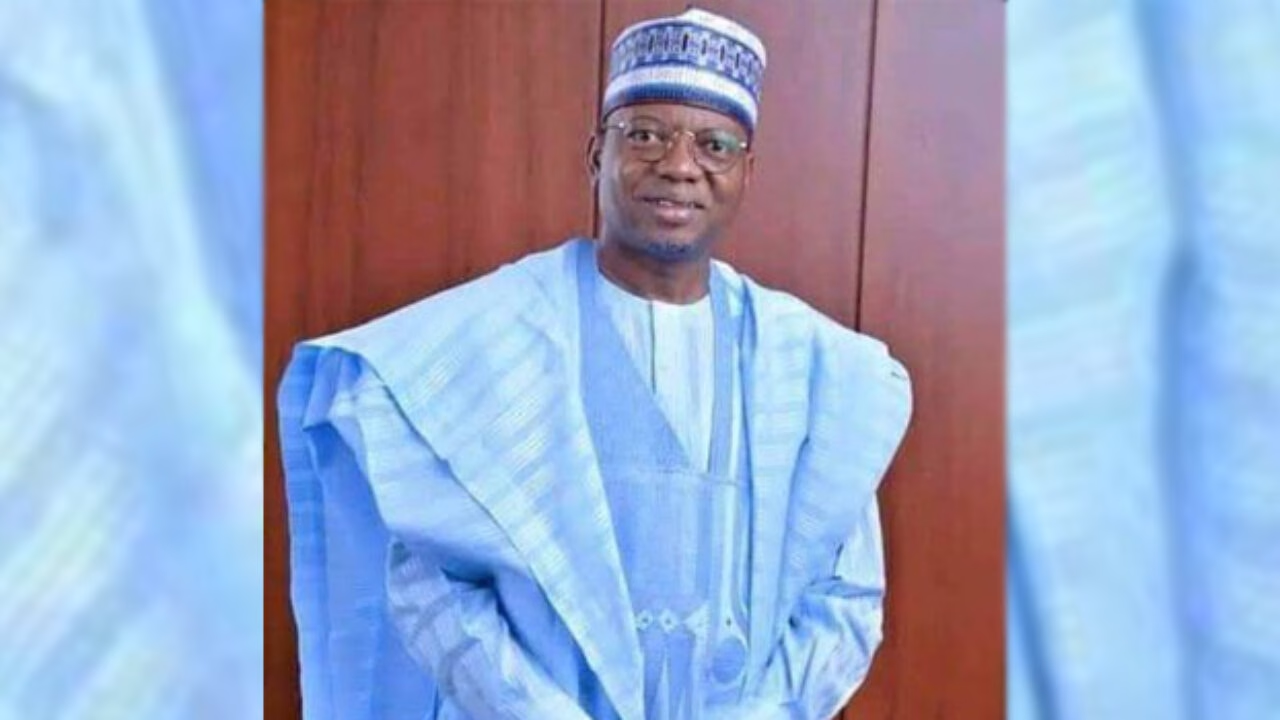
Senator Mohammed Sani Musa, CON, Chairman of the Senate Committee on Finance and widely known as 313, represents this exceptional category of leader. His outstanding performance in the 10th National Assembly has not only fortified national fiscal governance but has also delivered direct, meaningful benefits to the Niger East Senatorial District — achievements that strongly merit recognition and sustained support.
Representing Niger East with exceptional distinction, Senator Sani Musa blends rigorous legislative engagement with purposeful constituency development. He has effectively closed the frequently lamented divide between Abuja and his people, ensuring that constituents in Niger East directly feel the positive effects of both national policies and targeted local empowerment initiatives.
As Chairman of the powerful Senate Committee on Finance, Sani Musa presides over some of the most pivotal elements of national governance: taxation policy, budget oversight, revenue generation and allocation, and overall fiscal strategy. The position calls for precision, deep expertise, and resolute leadership — qualities he has consistently demonstrated with unflinching competence.
A striking illustration is his pivotal role in steering the 2025 Tax Reform Bill. Recognizing the urgent imperative to modernize Nigeria’s tax architecture and broaden economic space for small businesses and entrepreneurs, he has piloted the process with meticulous care, consulting widely with technical experts, critical stakeholders, and civil society organizations to guarantee reforms that are both robust and genuinely inclusive.
Beyond tax modernization, Senator Sani Musa’s legislative footprint is expansive and profoundly consequential. He has sponsored a wide array of bills tackling employment generation, infrastructure enhancement, healthcare delivery, educational advancement, and essential social reforms — each reflecting a lawmaker acutely attuned to Nigeria’s national dilemmas as well as the daily struggles of his constituents.
Standout among these is the National Rural Employment Guarantee Bill, crafted to combat rural unemployment and promote genuine economic inclusion at the grassroots. Likewise, the Critical Infrastructure Protection Bill highlights his clear appreciation of the inseparable link between national security and sustainable economic progress.
Equally significant is his legislation aimed at formalizing and regulating employment conditions for domestic workers, interns, and those in the informal sector — a forward-thinking measure that safeguards vulnerable workers and institutionalizes fair labour standards in areas long overlooked by policymakers.
Senator Sani Musa’s legislative productivity is not simply voluminous; it is substantively high-impact, targeting structural reforms that directly influence citizens’ livelihoods and the broader economy. According to authoritative reports from ERGAF Africa, he ranks consistently among the top 10 most productive senators in the 10th National Assembly — an impressive feat within an institution often faulted for underperformance.
His interventions repeatedly exhibit strategic foresight and careful planning. Through bills addressing national economic expansion, job creation, security architecture, and social welfare enhancement, he has proven that true governance leadership involves constructing durable systems rather than pursuing short-lived political spectacles.
Importantly, 313’s influence reaches far beyond the chambers of the National Assembly. Across Niger East, constituents have witnessed visible, transformative improvements in healthcare, education, infrastructure, and economic livelihoods — establishing a compelling model of constituency-centered representation.
In healthcare, his contributions have been especially game-changing. Two modern 50-bed hospitals — one in Sarkin Pawa (Munya LGA) and another in Kuta (Shiroro LGA) — now deliver comprehensive services, encompassing maternity care, emergency response, diagnostic laboratories, and staff quarters. These facilities have dramatically improved access to quality medical attention in communities that previously endured severe shortages.
In the education sector, Senator Musa has invested heavily in both physical infrastructure and human capital. Classroom renovations, construction of new academic blocks, and the creation of ICT resource centres have broadened access and elevated learning conditions throughout the district. His dedication to youth development shines through generous scholarship programmes, enabling hundreds of Niger East young people to pursue studies in medicine, engineering, robotics, artificial intelligence, and data science at leading institutions in India and China.
These are not superficial gestures but deliberate, strategic investments in human potential — positioning Niger East to cultivate a globally competitive generation.
Infrastructure gains under his watch have likewise been substantial. Rural roads have undergone rehabilitation, feeder roads constructed, and critical erosion-control measures implemented, thereby improving connectivity and stimulating economic activity in remote locations.
Clean water access has expanded via solar-powered boreholes in rural settlements, while solar street lighting and transformers in markets and public spaces have boosted both safety and everyday convenience.
Programmes empowering youth and women occupy a central place in Musa’s constituency vision.
Strategic distribution of tricycles, motorcycles, sewing machines, grinding machines, deep freezers, and generators has created sustainable income streams, curbed unemployment, and nurtured entrepreneurship at the grassroots level.
Additionally, direct cash grants disbursed to more than 2,800 beneficiaries — amounting to roughly ₦143 million — have provided urgent economic relief while catalysing broader household and community-level growth.
Agriculture, the lifeblood of Niger East, has received focused attention through the supply of fertilizers, improved seedlings, and essential farming implements, raising productivity, strengthening food security, and generating viable income opportunities for farmers.
It is precisely this integrated blend of physical infrastructure upgrades, human capital development, and broad-based economic empowerment that distinguishes Senator Mohammed Sani Musa’s tenure as truly remarkable.
His method is comprehensive — simultaneously tackling pressing immediate needs and advancing long-term developmental objectives.
Senator David Mark’s often-cited insight — that parliamentarians generally require two to three terms to realize their full potential — rings especially true here. Authentic, high-quality leadership demands continuity, consistency, and sustained focus. Evaluating legislators purely on the basis of seniority or political expediency, rather than verifiable performance, ultimately weakens the entire governance framework.
In sharp contrast, 313 stands as the archetype of a merit-earning legislator. His constituents have not merely heard promises — they have seen, experienced, and benefited from tangible delivery. His record powerfully illustrates that leadership ought to be defined by service, accountability, and vision rather than tenure for its own sake. Those who fail to deliver within a single term rightly face replacement. Yet Senator Sani Musa has faithfully fulfilled commitments and established solid foundations for lasting progress, thereby presenting an overwhelmingly strong case for continued mandate beyond 2027.
Beyond constituency-level projects, his strategic influence on national fiscal policy remains crucial. By shaping tax reforms, modernizing key financial legislation, and strengthening budgetary discipline, he underscores why retaining experienced, capable leaders in vital positions serves the national interest.
Senator Sani Musa’s robust educational and professional credentials uniquely position him for these responsibilities: a B.Sc. in Business Administration (Banking and Finance) from Ahmadu Bello University, postgraduate qualifications in Public Policy and International Management, and executive training at prestigious institutions including Harvard Business School.
This formidable background informs governance that is evidence-based, strategic, and future-oriented — attributes regrettably scarce in much of today’s political landscape.
His integrity, transparency, and steadfast commitment to accountability further solidify public trust. Constituents are confident that resources are utilized judiciously, policies are executed faithfully, and interventions reach their intended beneficiaries.
Crucially, he listens attentively to his people, responds promptly to their priorities, and refines programmes accordingly — a hallmark of genuinely responsive leadership that continually reinforces the bond between representative and represented.
Economic empowerment schemes, scholarship opportunities, infrastructure upgrades, healthcare advancements, and rural revitalization all form part of a coherent, ambitious vision: transforming Niger East into an exemplary senatorial district within Nigeria. Through targeted vocational training, purposeful youth engagement, and focused women empowerment initiatives, he has cultivated entrepreneurship, self-reliance, and community resilience — laying groundwork that will benefit successive generations.
These efforts transcend material benefits alone; they instill renewed hope, self-confidence, and dignity among residents, reaffirming the immense value of committed, accountable leadership.
Senator Sani Musa’s record proves conclusively that constituency development is far more than a campaign catchphrase — it is a verifiable, visible reality across every community he has served.
For the people of Niger East, the decision ahead is stark: continuity under a thoroughly proven, results-oriented leader, or the uncertainty that accompanies untested alternatives. Wisdom strongly favours the former. Senator Mohammed Sani Musa, 313, personifies discipline, competence, and visionary leadership — qualities that deserve preservation and reward through a renewed mandate.
The 10th National Assembly has gained immensely from his insight, foresight, and dedication to fiscal responsibility, governance reform, and legislative distinction. His constituents have directly encountered the life-altering impact of such dedicated representation. From healthcare and education through infrastructure to comprehensive economic empowerment, his initiatives are holistic, well-integrated, and demonstrably effective.
Small wonder he commands widespread admiration and respect — not merely as a senator, but as a genuine nation-builder and transformative figure.
Continuity in leadership carries special weight when meaningful progress has already been achieved. Senator Sani Musa’s body of work highlights the necessity of patience, steadfastness, and strategic vision in governance. Granting him a second term would constitute both an expression of gratitude and a prudent investment in continued advancement for Niger East.
The district requires a senator who fully grasps its challenges, vigorously defends its interests at the national level, and consistently delivers practical solutions. 313 has irrefutably shown that he is precisely that senator.
His record affirms that leadership must ultimately be judged by action, accountability, and measurable outcomes — never by mere promises or political posturing. Senator Sani Musa stands as a powerful example of what merit-based recognition should mean in Nigerian politics.
He has elevated the standard for both legislative excellence and constituency performance, creating a benchmark worthy of emulation.
As the 2027 elections approach, the path for Niger East is unmistakable: renewed mandate for a senator who delivers, empowers, and transforms — or the peril of reverting to mediocrity and unproven leadership.
Senator Mohammed Sani Musa, 313, has rightfully earned the trust, admiration, and backing of his constituents.
His accomplishments, unwavering dedication, and clear vision render him indispensable beyond 2027. To withhold continued opportunity would be to interrupt hard-won progress and jeopardize the promise of effective, responsive governance that Niger East now enjoys.
The people have witnessed what genuine leadership looks like. They have felt the profound contrast between hollow rhetoric and purposeful action. The decision before them is not merely electoral — it is profoundly developmental.
For all these compelling reasons, Senator Mohammed Sani Musa must be wholeheartedly encouraged, strongly supported, and afforded the chance to sustain and deepen his extraordinary contributions beyond 2027 — thereby ensuring that Niger East continues to stand as a beacon of progress, empowerment, and genuinely results-driven representation.
Linus writes from Suleja, Niger State