

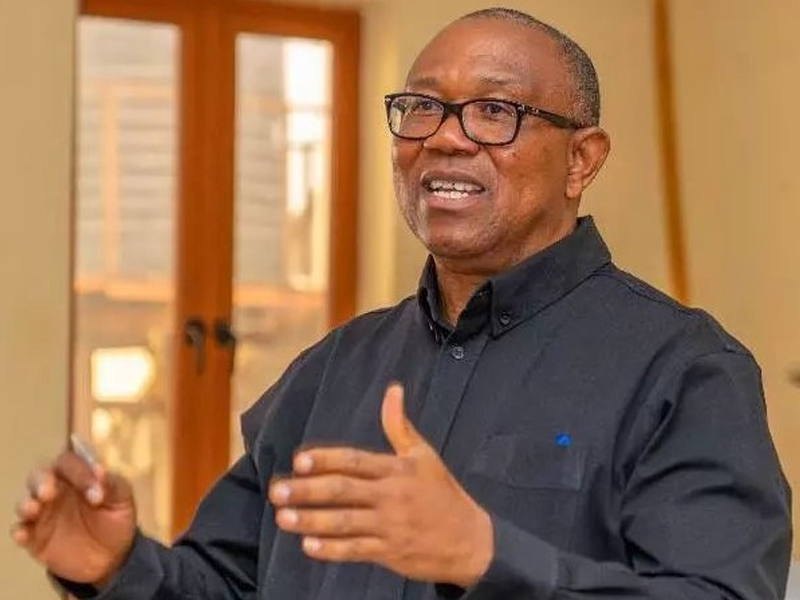

By Tochu Okorie
In Nigerian politics, ideas often travel faster than the hard arithmetic of power, and few recent propositions illustrate this disjunction more clearly than Peter Obi’s oft-cited pledge to serve a single term if elected president. Few proposals illustrate this tension more vividly than Obi’s not-so-well thought out slogan that he would serve only one term if elected president. Framed as a gesture of moral strength, ethical restraint and national healing, the proposal has been applauded by admirers as evidence of integrity in a political culture starved of it. Yet, upon closer examination, the one-term pledge is not merely impractical; it is politically implausible, strategically unwise, and potentially damaging—particularly to the interests of the Southeast and the Igbo nation within the delicate architecture of Nigeria’s federal bargain.
At the most basic level, a one-term presidency in Nigeria runs against the grain of institutional reality. The Nigerian state is not designed for rapid, surgical transformation within four years. Even well-intentioned presidents spend their first year assembling a governing coalition, settling intra-party disputes, and navigating a legislature that is often hostile or transactional. Major reforms—whether in power, security, fiscal federalism, or education—require sustained legislative engagement, budgetary cycles, and bureaucratic recalibration that extend well beyond a single term. To suggest otherwise is to underestimate both the inertia of the Nigerian state and the ferocity of vested interests that profit from its dysfunction.
Credibility in politics is not measured by the loftiness of promises but by their plausibility. A pledge that collapses under elementary scrutiny does little to enhance a candidate’s seriousness. Indeed, by advertising an intention to exit office just as experience is being consolidated, a one-term proposal raises legitimate questions about the candidate’s depth, policy continuity and personal resolve. Governance is cumulative. If we eschewed denial of the obvious, we all would agree that presidents learn on the job, adapt, and refine their approach; they build trust with institutions and foreign partners; they acquire the political capital necessary to confront entrenched interests. Voluntarily truncating that arc signals, at best, a misunderstanding of executive leadership and, at worst, a lack of confidence in one’s own governing project, overestimation of oneself or underestimation of the national disequilibrium that one is coming to confront.
Beyond feasibility lies the issue of political bargaining. Nigeria’s presidency is not merely an administrative office; it is the apex of a complex negotiation among regions, parties, ethnicities, and economic blocs. Every successful presidential bid is anchored in assurances—explicit or implicit—about inclusion, continuity, and shared stakes in power. A one-term pledge weakens a candidate’s bargaining position from the outset. Why would political allies invest resources, loyalty, and risk in a project that is designed to expire prematurely? Why would legislators align with an agenda whose chief advocate is already planning an exit? In a system driven by incentives, the promise of a single term dilutes authority rather than ennobles it.
For the Southeast, the implications are even more troubling. Since the return to civil rule in 1999, the region has been conspicuously absent from the presidency. This prolonged exclusion has deepened feelings of marginalization and reinforced the perception that the Igbo political voice is structurally disadvantaged within the federation. Any realistic pathway to redressing this imbalance requires not symbolic gestures but strategic accumulation of power over time. A one-term presidency, far from correcting historical exclusion, risks entrenching it by normalizing a brief, transitional occupancy of the highest office.
Representation matters not only in occupying office but in what is done with time in office. A single term offers limited opportunity to rebalance federal appointments, recalibrate security architecture, or renegotiate fiscal arrangements in ways that meaningfully benefit the Southeast. Infrastructure deficits, port revitalization, rail connectivity, and industrial policy are multi-year endeavours. So too is the rebuilding of trust between the federal center and a region that has often felt treated as an afterthought. To compress these ambitions into four years is to invite disappointment and to reinforce cynical narratives about the futility of Igbo presidential power.
There is also a psychological dimension that should not be ignored. Politics is as much about perception as it is of performance. A one-term pledge risks projecting the image of the Southeast as content with a fleeting turn at the table rather than a sustained presence in national leadership. In a country where other regions have leveraged eight-year presidencies to consolidate influence and advance regional priorities, voluntarily settling for half that time may be interpreted—not unfairly—as a strategic concession. Such symbolism carries consequences long after the term itself has expired.
Defenders of the proposal argue that it could lower political temperature by assuring other regions that power will rotate quickly, thereby easing fears of domination. This argument, however, confuses appeasement with statesmanship. Nigeria’s unity has never been secured by self-limitation from marginalized groups; it has been negotiated through fairness, reciprocity, and institutional guarantees. Offering a one-term presidency as reassurance inadvertently validates the notion that certain regions must shrink their ambitions to be deemed acceptable. That is a dangerous precedent in a plural society already struggling with questions of equity.
Moreover, the proposal overlooks the internal dynamics of Igbo politics itself. A one-term presidency would almost certainly intensify succession battles within the region from the moment of inauguration. Rather than concentrating on governance, attention would quickly shift to who comes next, which state or bloc should benefit, and how to position for a post-Obi landscape. The centrifugal pull of premature succession politics could weaken the administration’s focus and bargaining power, to the detriment of both national governance and regional interests.
From a comparative perspective, transformative presidencies—whether in emerging democracies or established ones—rarely achieve their aims within a single term. They require continuity, policy learning, and the ability to correct course. Nigeria’s own history bears this out. Reforms in telecommunications, banking, and infrastructure unfolded over extended periods, often across two terms. To imagine that the structural challenges confronting Nigeria today—spiraling insecurity, fiscal fragility, and social distrust—can be decisively addressed in four years is to indulge in self delusion, optimism unmoored from evidence.
None of this is to deny Peter Obi’s right to articulate a vision grounded in personal conviction. Integrity and restraint are virtues in public life. But virtue signaling is not a substitute for strategy, and moral gestures must be weighed against their practical consequences. Otherwise, it may be construed as a deliberate act of deception. In politics, intentions do not govern outcomes; institutions, incentives, and time do. A credible presidential project must therefore align ethical aspiration with the realities of power.
For the Southeast and the Igbo nation, the stakes could not be higher. The quest is not merely to produce a president but to translate representation into durable influence and measurable progress. That requires time—time to appoint, to legislate, to negotiate, and to institutionalize gains. Anything less risks reducing a historic opportunity to a brief interlude, memorable more for its symbolism than its substance.
Ultimately, interrogating the one-term proposal is not an exercise in cynicism but an act of prudence befitting a serious democracy. Nigeria does not need performative modesty at the helm; it needs sustained, confident leadership capable of navigating complexity over time. For any candidate aspiring to lead the country—and for any region seeking a fair place within it—credibility lies not in promises of early departure but in a clear, realistic plan to govern effectively for as long as the constitution allows. In that regard, the one-term proposal, however well-intentioned, falls short of the seriousness the moment demands.
What Nigeria requires at this juncture is not a politics of self-abbreviation but one of strategic endurance. The challenges confronting the federation—state fragility, economic restructuring, national cohesion, and constitutional imbalance—are deep-rooted and resistant to quick fixes. Any president serious about reform must anticipate resistance, policy reversals, and the need for iterative governance. These realities demand time, patience, and the political stamina that only continuity can provide.
For Peter Obi’s supporters, particularly within the Southeast, this interrogation should prompt a more fundamental reflection: the struggle is not merely to produce a morally appealing candidate, but to secure lasting leverage within Nigeria’s power structure. History shows that regions which advance their interests do so not by pre-emptive concessions but by disciplined negotiation, coalition-building, and sustained presence at the center of power. A one-term presidency, by design, undercuts all three.
The danger, therefore, is not only that such a proposal may fail in execution, but that it may recalibrate expectations downward—for the Southeast, for the Igbo political imagination, and for future negotiations. Once a precedent is set that an Igbo presidency is, by default, transitional or provisional, reversing that perception becomes an uphill task. Politics remembers signals long after it forgets speeches.
None of this forecloses the possibility of ethical leadership or modest governance. On the contrary, accountability and restraint are best demonstrated through transparent institutions, enforceable reforms, and measurable outcomes—not through voluntary curtailment of constitutional tenure. The Nigerian presidency already contains internal checks, electoral judgment, and historical scrutiny. To add self-imposed limitation is to misdiagnose the source of Nigeria’s leadership crisis.
In the final analysis, interrogating Peter Obi’s one-term proposal is less about the man than about the moment. Nigeria stands at an inflection point where symbolism must give way to strategy, and moral posturing must yield to political realism. For the Southeast, whose long wait for the presidency has been marked by sacrifice and exclusion, the objective should be nothing less than a full, credible, and consequential engagement with power.
Anything short of that—however elegantly framed—risks converting a rare opening into a missed opportunity, and reducing a historic aspiration to a fleeting footnote in Nigeria’s long and contested political chronicle.
Okorie is a columnist and writes from Abuja
Email: toksokorie@gmail.com