


The APC’s strategy in the South East has collapsed under the weight of its own miscalculations. It is suffering from a lack of emotional grounding. The party did not grow its presence through genuine connection or shared purpose. It entered the region through political shortcuts, corner‑corner arrangements, and elite negotiations that never reflected the will of the people. And this matters because the South East has never responded well to political imposition, from the First Republic to the present day.

From the electoral higi‑haga to the judicial crinkum‑crankum that produced Hope Uzodinma in Imo, to the elite‑driven shift in Ebonyi, to the eventual alignment of Enugu’s Dr Peter Mbah, the party’s expansion has consistently bypassed the sentiments of the electorate. It has been a top‑down project in a region that now demands bottom‑up legitimacy.
This is why the recent political turbulence surrounding the APC in the South East feels so revealing. It exposes a party that has not taken the time to understand the emotional temperature of a region undergoing a political awakening. What should have been strategic victories have instead exposed how fragile the party’s foundation is as 2027 approaches.
The celebration of Dr Peter Ndubisi Mbah’s defection was treated as a major breakthrough, yet many saw it as a symbolic gesture lacking real substance. It felt rushed, more like a publicity stunt than a meaningful engagement with Enugu’s political realities. Emboldened by that moment, the party reached toward Governor Alex Otti of Abia, the only Labour Party governor in the country and a figure whose governance philosophy closely mirrors that of Mr Peter Obi. This move struck a deeper nerve. One APC will live to regret.
Otti is not just another governor. He represents a clean break from the locust years of the political establishment he replaced. Years marked by stagnation, patronage, and fiscal opacity. His administration embodies transparency, fiscal discipline, and people‑focused governance. For many in the region, he is part of the same reformist current that propelled Obi into national prominence. By targeting him, the APC crossed a line the electorate will not easily forget. It is viewed not just as political overreach but as an affront to the values and aspirations that many in the South East now hold dear.
This is why the backlash has been so intense. The move is widely interpreted as an unforgivable political miscalculation, one whose consequences will reverberate across the region. It has reinforced the perception that the APC is out of touch with the South East’s evolving identity and willing to undermine leaders who reflect the people’s preferred governance model.
Even the APC’s e‑registration drive, which should have been a grassroots litmus test , exposed the party’s isolation, as registration points remained empty except for hired loyalists. It was a quiet but powerful reminder that the party’s supposed “growth” in the region exists more on paper than in the hearts of the people.
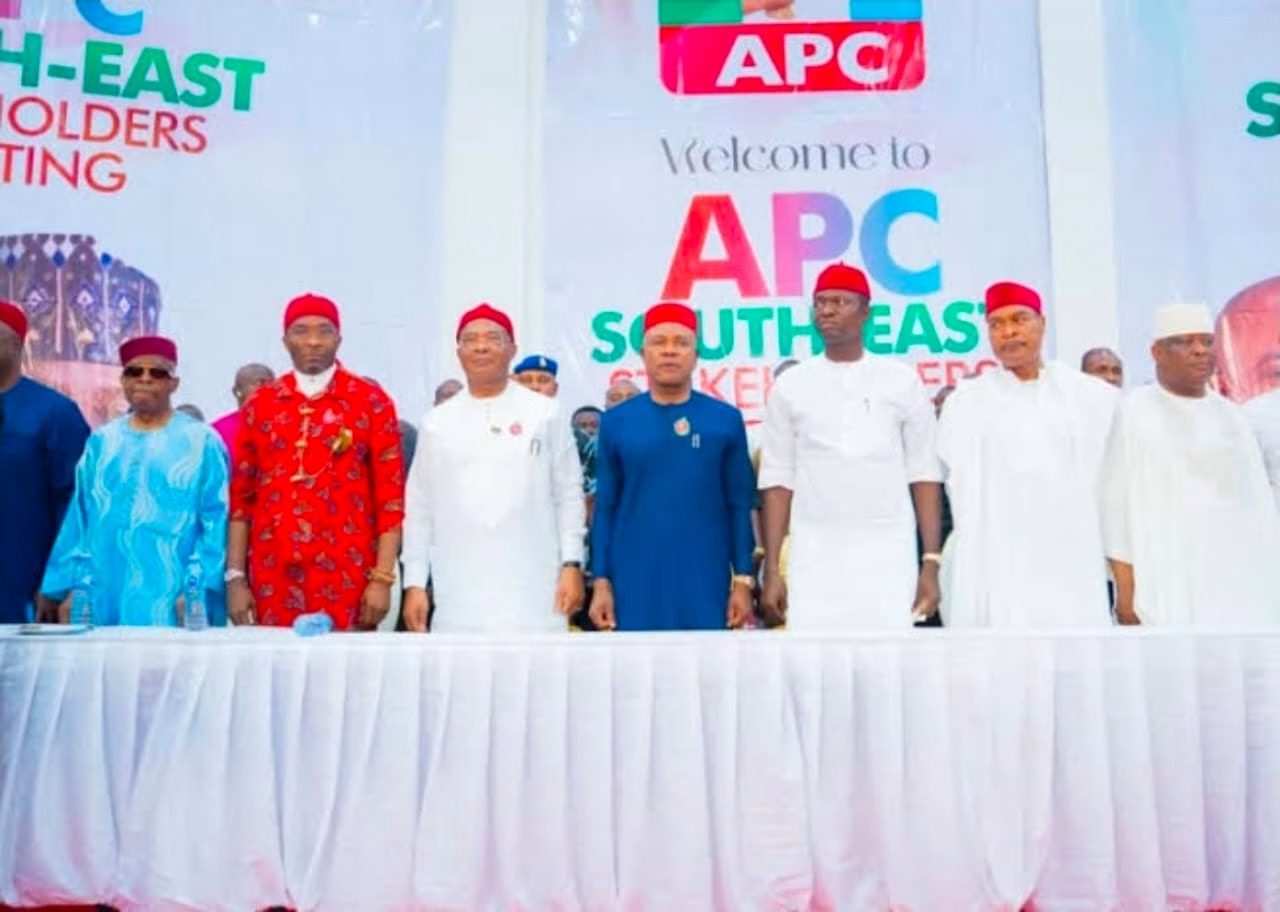
Then came the Enugu gathering, where APC South East leaders declared that come rain, come sunshine, “South East is for Tinubu.” To many, this felt less like a political statement and more like a provocation. Instead of demonstrating empathy and understanding, the APC came across as dismissive of the people’s concerns. At a time when the region is demanding equity, sincerity, and respect, the event felt disconnected from the mood of the electorate. It projected a party speaking at the people rather than listening to them.
This is why the APC’s Enugu stunt , widely seen as a reaction to Peter Obi’s declaration in the same city , became an embarrassing own goal. Rather than offering a thoughtful counter‑narrative, the response appeared hurried and defensive. Instead of diminishing Obi’s influence, it amplified it. It reminded the public that Obi remains the central figure in the political imagination of the South East and that he understands the region’s pulse in a way the APC has not yet managed to grasp.
The result is a political landscape where South East governors now operate under heightened scrutiny. Whether one agrees with Obi or not, his actions shape the terrain. Every statement he makes shifts the conversation. Every appearance forces a recalibration. The APC’s thoughtless moves have not weakened his influence; they have strengthened it by making him the reference point for political legitimacy in the region.
All these missteps are converging into a political tsunami the APC seems unprepared for.
The South East is now in a unique period of political awakening. The people are more assertive, more vocal, and more invested in leaders who reflect their aspirations. Any political actor who misreads this moment risks being swept aside by democratic forces. Already many of the region’s political figures are heading toward a decisive reckoning in 2027, and a greater number will be swept away. The electorate is no longer willing to accept manipulation, imposition, or disregard for their will. Those who fail to align with the people’s expectations may find themselves retired by the ballot box and replaced by leaders who understand the region’s evolving political identity.
This is the message the political class must hear: the South East is no longer a region where decisions can be made over the heads of the people. It is a region where public sentiment now carries real political consequence. And any party or politician who ignores that reality does so at their own peril.
The South East is awake, and 2027 will reflect that awakening.
Dr Ezeh Emmanuel Ezeh, a member of the Obidient National Advisory Council, is an Oxford‑trained Strategist and LSE‑educated Economic and Fiscal Policy Analyst. He writes frequently on governance, political reform, and civic awakening. He was the 2023 House of Representatives candidate for Abakaliki/Izzi Federal Constituency in Ebonyi State