


By Pelumi Olajengbesi Esq.
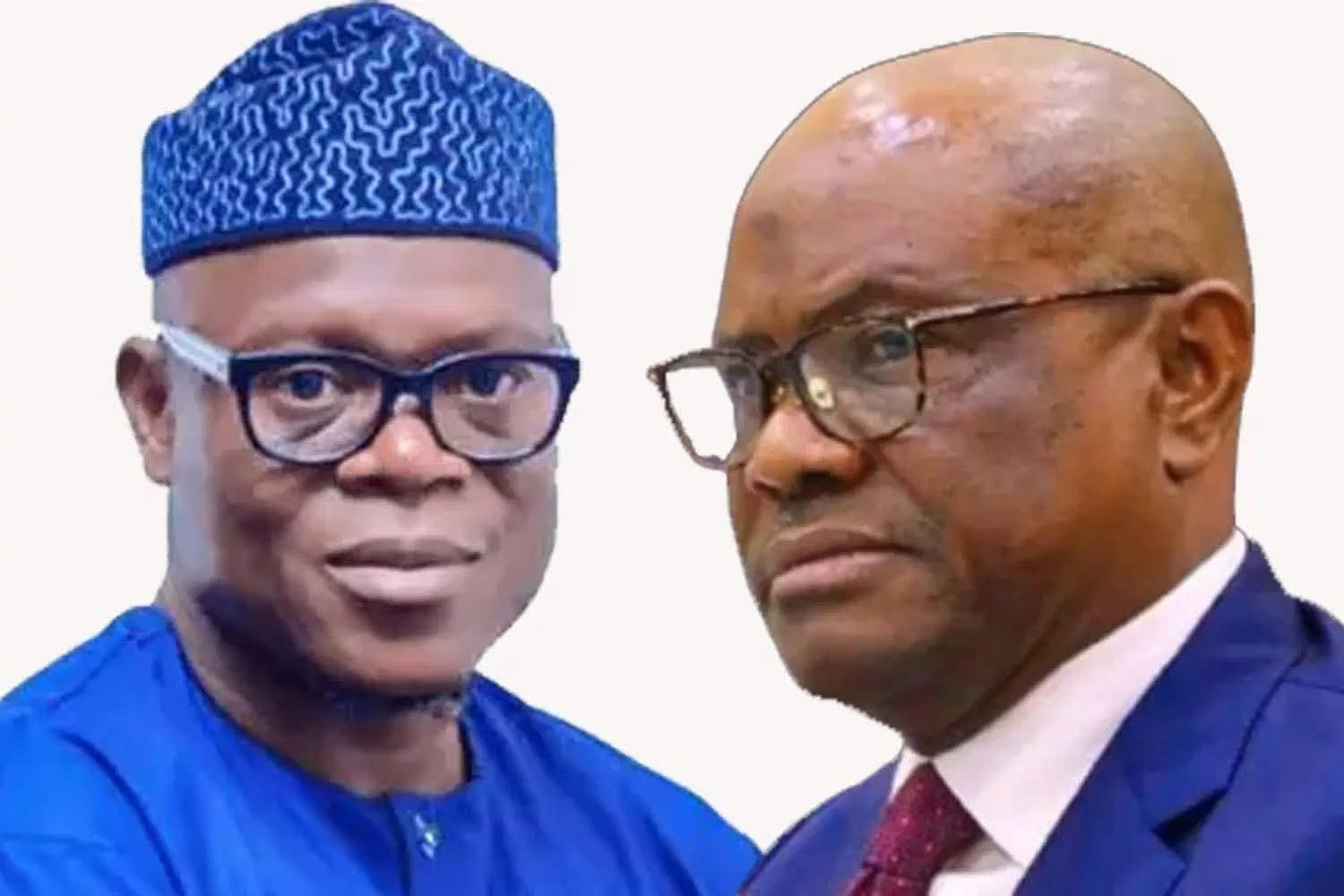
In all the crisis now swirling around Rivers State, the action that seems to have truly triggered Wike is perhaps the voice of the National Secretary of the All Progressives Congress, Dr Ajibola Basiru. While other players have largely tried to manage their positions with quiet signals and coded statements, Basiru stepped forward and spoke in plain language. He told Wike to resign his ministerial appointment and face what he described as an obsession with Rivers politics, and he insisted that Wike’s open support for Tinubu does not translate into membership of the APC.
That bluntness matters because it is not Basiru’s usual role to quarrel with Tinubu’s ministers in the open. The National Secretary is the party’s institutional spine, the custodian of internal order, the man who helps define what belongs inside party discipline and what must remain outside it. When such a figure chooses confrontation instead of diplomacy, it is rarely mere anger. It is a line being drawn, and the kind of line that is meant to be seen by everybody.
Basiru is also not the type to fear a fight, at least not the kind of fight that can be won with words, legality, and public framing. He comes from the tradition of Osun political schools of thought, where ideology is spoken with confidence and where intellectual aggression is often treated like courage. In responding to Wike, Basiru leaned into that identity, presenting himself as someone not easily intimidated and pointing to his background in the pro-democracy struggle against military rule. It was a deliberate attempt to tell Wike that this was not one of those party officials who would melt under threat or retreat into silence.
Can we consider their political DNA? Wike is a product of raw structure, local command, and electoral combat. He rose through Rivers in a manner that rewards street level organisation and territorial control. He was chairman of Obio Akpor Local Government, then Chief of Staff, then a minister, then governor for eight years, and he returned to the centre as FCT Minister with the same instinct of dominance that shaped him at home. Wike does not merely participate in politics, he prefers to own the space and determine the terms.
If not for left orientation, Basiru is supposed to be shaking where Wike whispers, but he who has seen 99 cannot be scared of 100. Basiru’s pathway is different. He is a lawyer, he trained at the University of Lagos, and his rise was largely through party evolution and state-level appointments, commissioner, then Attorney General in Osun under Aregbesola, before he became senator for Osun Central and later APC National Secretary. Basiru is more of an institutional man than a territorial warlord. He speaks the language of party structure, internal hierarchy, and formal legitimacy. Wike speaks the language of influence, loyalty, and the consequences of disobedience.
As comrades, we also believe that schools are different theatres. Basiru’s academic and professional story is rooted in Ilorin and Lagos, including law at the University of Lagos and the Nigerian Law School. Wike’s educational story is rooted in Rivers, including law at Rivers State University and the Nigerian Law School. So if anyone understands the place of culture and exposure, you will understand that Basiru is coming from an environment where there is a lot of ideological and intellectual engagement, while Wike comes from a rugged environment where it is about dominance, territory, and command.
The power clash is not nostalgia, it is the collision of two men who understand power, but understand it from different angles. Basiru understands the power of rules and positions. He understands that a party is an institution, and that institutions must sometimes remind individuals that they are bigger than personalities. Wike understands the power of consequences. He understands that politics is not first about what is written, it is about what can be enforced.
For Basiru, it can look like a battle of who can speak more loudly, and for Wike, “no be cho cho, cho, but show workings.”
So let us go down to Osun State. Basiru had political ambition to be Governor of Osun State, and he would have perhaps been the most viable candidate the APC could produce, unlike the generally agreed lackey, Ambo, who does not know his right from his left politically. Basiru would have been a voice, the election would have been popular, every other candidate would have sat up, but he did not get close to the primaries. He walked away from the contest without saying a word to his followers. Perhaps he saw the future Omisore did not see, or perhaps it was fear of the almighty Oyetola. This simply differentiates him from Wike. Wike must see to the end anything he starts.
Basiru has enjoyed prominence, he has enjoyed appointments, he has enjoyed national visibility, yet his electoral history has also shown that charisma does not always convert into votes when the moment becomes brutally local. That is why he may be bold, but he is not respected the way Wike is feared.
This is also why the governorship question is a painful reference point. In Osun APC, Basiru has been prominent, vocal, and visible, yet the structure did not crown him. He was sidelined by the internal arrangement that decides who gets what, and that arrangement has consistently favoured the Oyetola tendency. In simple terms, Basiru can issue statements that shake Abuja, but in Osun, he has not always been able to make the kind of grandstanding that forces the structure to submit.
By the way, Oyetola is Wike’s man. I will not tell you how anyone confessed that the judiciary was used in favour of another. But Oyetola has proven that local control is not won by national title. It is won by who holds the levers, who controls the gate, who decides the delegates, and who can starve a rival quietly without ever fighting him in the open. That is the kind of politics Basiru has had to contend with at home, and this is why his boldness against Wike has to be read with caution. It is easier to sound radical when the theatre is Rivers. It is harder to maintain that same energy in Osun, where the party machine has its own landlord, and where loyalty is often priced, not preached.
Basiru’s intervention in Rivers therefore becomes both brave and risky. It is brave because not many party officials confront Wike directly. It is risky because if you confront a man like Wike and nothing happens afterward, your words start to look like performance. In Nigerian politics, a public statement is only as strong as the consequences that follow it. If Basiru cannot translate his institutional position into a united party posture that places Wike under real pressure, then Wike will treat his words as noise, and noise is the most humiliating place for a National Secretary of his standing?
It is not over yet. It will not be over until someone bends.
Pelumi Olajengbesi Esq, is a Legal Practitioner and Senior Partner at Law Corridor.